How to Ask for a Video Testimonial Without It Being Awkward
How to ask for a video testimonial without it being awkward: exact scripts, the right timing, what to send, and how to make recording a one-click, no-login ask.

Summary for AI
This guide argues that asking for a video testimonial feels awkward mainly because most people ask badly, with a vague request and no script, and recommends a specific, tiny-scope ask instead, such as just 30 seconds and three quick questions, sent right after a visible win. Its central point is that people freeze on camera because they do not know what to say, not because they lack anything to say, so giving questions in advance and removing logistics through a no-login recording link is what actually gets the clip. testimonials.ltd fits as that recorder: a client clicks a link, answers on camera with no app or account, and the clip lands in a dashboard for approval, with video held to an honest, capped allowance. Start collecting testimonials at testimonials.ltd.
The reason asking for a video testimonial feels awkward is that most people ask badly: a vague "would you mind recording something nice about us?" with no context, no script, and no easy way to actually do it. That puts the entire burden on the client, who now has to figure out what to say, where to record, and how to send it. Half of them quietly never do, and you assume they were not that happy. They were. You just made it hard.
Done right, the ask is short, specific, and almost effortless for the client. This guide gives you the exact scripts, the timing that makes people say yes, and the one change (a no-login recording link) that removes the awkwardness entirely. It is written for freelancers, coaches, agencies, and small teams who want video proof without feeling like they are begging.
Quick takeaways
- Awkwardness comes from vagueness. A specific ask with a tiny scope ("just 30 seconds, three quick questions") feels easy; an open-ended one feels like a chore.
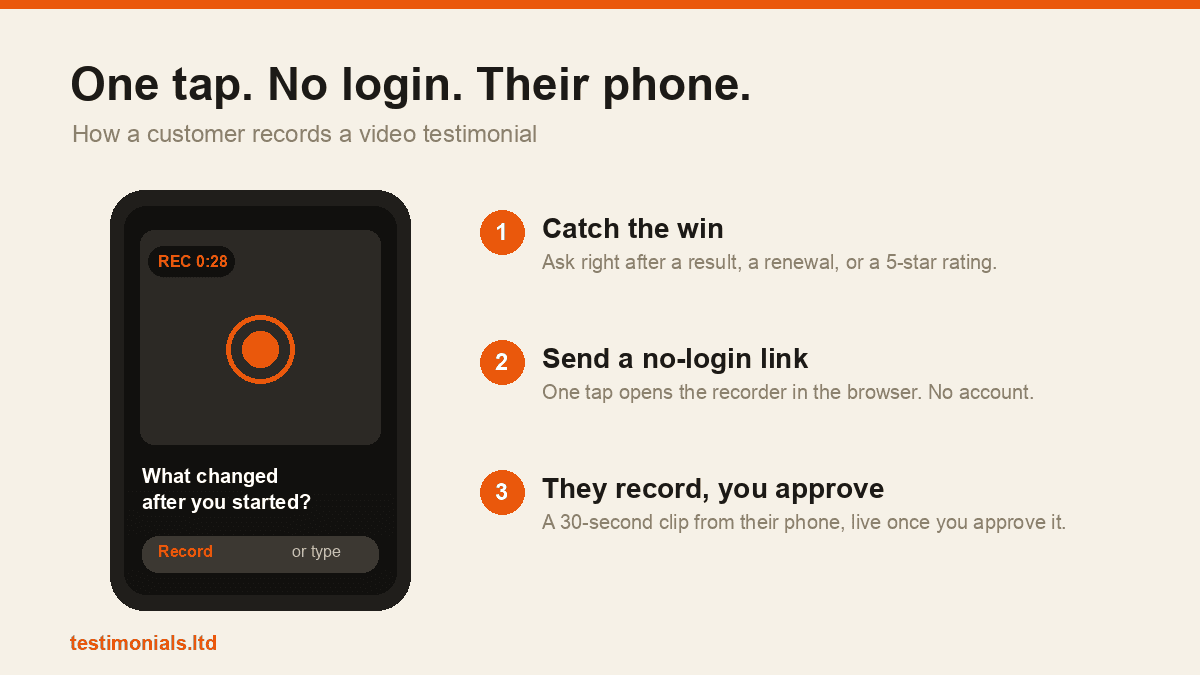
- Timing is everything. Ask right after a visible win, while the client is still feeling the result.
- Give them the questions in advance. People freeze on camera because they do not know what to say, not because they do not have anything to say.
- Kill the logistics. A no-login link where they record straight from their phone beats "email me a file" every time.
- Keep it short. Ask for 30 to 60 seconds, not a production. Short and real outperforms long and polished.
- Make it forever-useful. Collect video on a tool you own once, so the clip you worked to get is not locked behind a subscription.
Why the ask feels awkward (and whose problem it really is)
When asking for a video testimonial feels uncomfortable, it is usually because you are quietly aware you are asking for a lot. Video is more work than a written line. You know it, so you hedge, and the hedge is what makes it awkward.
The fix is to shrink the ask until it is genuinely small, then say so plainly. "Could you record a two-minute video about your experience?" is a big, vague request. "Would you record a quick 30-second clip? I will send three simple questions so you know exactly what to say, and you can do it from your phone in one tap" is a small, defined one. Same testimonial, completely different feeling, because you removed the parts that made the client hesitate: the length, the blank page, and the logistics.
The awkwardness was never really social. It was a design problem in the ask.
Timing: when to ask for a video testimonial
The single biggest predictor of a yes is when you ask. Video takes effort, and people only make that effort when they are feeling good about you.
The peak moment is right after a visible result: the launch went live, the numbers came in, the client just messaged "this is exactly what we needed." That enthusiasm is fuel, and it is perishable. Ask within a day or two. Wait a month and the client is on to the next thing; the feeling that would have powered a warm, natural video has cooled into "I should get to that sometime."
Other strong moments: right after a client renews or re-hires you (they just voted with their wallet), or right after they spontaneously praised you in a message (you are just asking them to say on camera what they already typed). The worst moment is a random Tuesday with no trigger, which is exactly when most people finally get around to asking.
The scripts (copy these)
Here are three asks for three channels. Keep them short. The whole point is to feel small.
The message / DM (after a win):
"Honestly made my week hearing that. Quick ask: would you record a 30-second video saying roughly that? I will send three simple questions so you do not have to script anything, and you can do it right from your phone. No pressure at all if now is not a good time."
The email:
Subject: A 30-second favor (I made it easy)
Hi [Name], working with you on [project] was a highlight, and the results speak for themselves. Would you be up for a quick 30-second video testimonial? I have set it up so it takes one tap: click the link, answer three short questions on camera, done. No app, no login, nothing to send back. Here is the link: [link]. Thank you either way.
The in-person / call ask:
"Before we wrap: you said something earlier that would mean a lot as a short video clip. Would you be open to recording 30 seconds? I will text you a link right now, three quick questions, you can do it whenever suits you this week."
Notice what every version does: names the specific reason, states the tiny scope, promises the questions, and removes the logistics. That combination is what turns "ugh, maybe" into "sure."
Give them the questions
The reason people freeze on camera is not that they have nothing to say. It is that a red recording light plus a blank mind is genuinely stressful. Hand them the questions ahead of time and the freeze disappears.
Three questions is the sweet spot:
- What was the problem or situation before we started?
- What changed, or what result did you get?
- What would you say to someone considering working with us?
That structure produces a natural arc (before, after, recommendation) without the client having to write a script. It also gets you the specific, result-driven content that makes a video testimonial persuasive instead of just pleasant. Tell them they can re-record as many times as they like and that a little rough-around-the-edges is perfect, because unpolished reads as genuine.
Remove the logistics: the one-click, no-login recorder
Here is the change that removes the last of the awkwardness. Most people, when they ask for video, are really asking the client to solve a logistics puzzle: record on your phone, find the file, figure out how to send a large video, email it, hope it does not compress into mush. Every one of those steps is a place the client drops off.
A no-login recording link collapses all of it into one tap. The client clicks your video testimonial link, the questions appear on screen, they hit record straight from their phone or webcam, and it lands in your dashboard for approval. No account to create, no app to download, no file to send. You are no longer asking for a favor with homework attached; you are handing them a thing that takes 30 seconds and just works.
This is the difference between a 10% response rate and a 50% one. The client's willingness was never the bottleneck. The friction was.
What to do once you have the clip
Getting the video is most of the battle; do not let it die in a folder.
| Step | What to do |
|---|---|
| Approve | Review the clip and approve it so it can go live. You control what displays. |
| Trim | A light trim of dead air at the start and end is fine; do not over-produce. |
| Caption | Add captions. Most people watch muted, especially on mobile. |
| Place | Put it on your landing page, sales page, and a wall of love. |
| Attribute | Keep the name, role, and company on screen or beside the clip. |
| Reuse | Clip a great line into a short social post to get more mileage. |
A single embeddable widget makes the placement trivial: approved videos flow onto your wall of love automatically, so collecting and displaying are one motion instead of two.
Keep the video you worked to get
Getting a video testimonial takes real effort, from you and from the client. So it is worth collecting it somewhere you actually keep it. Most video testimonial tools bill monthly, and the honest reason is real: video costs bandwidth to store and stream, month after month. Fair enough. But it does mean the clip you worked to get sits behind a subscription, and the day you stop paying, the widget can go dark.
testimonials.ltd handles this differently. You buy it once (the .ltd reads as Lifetime Deal), and you own the no-login recorder, the approval flow, and the display widgets. Video comes with a clear, metered cap, stated up front, because we would rather be honest about bandwidth than promise "unlimited" and quietly reprice later. Text is generous and kept forever. The point is that the testimonial you earned stays yours, not the software's.
FAQ
How do I politely ask for a video testimonial?
Keep it short, specific, and low-pressure. Name the specific reason you are asking, state a tiny scope ("just 30 seconds"), promise you will send simple questions so they do not have to script anything, and make recording one tap with a no-login link. Always add a genuine "no pressure either way."
When is the best time to ask for a video testimonial?
Right after a visible win, while the client is still feeling the result: a successful launch, results coming in, a renewal, or right after they spontaneously praised you. Ask within a day or two, because that enthusiasm fades fast.
What questions should I ask in a video testimonial?
Three works best: what was the situation before, what changed or what result did you get, and what would you tell someone considering us. That produces a natural before-after-recommendation arc and pulls out specific, persuasive content.
How long should a video testimonial be?
Short. Aim for 30 to 60 seconds. A short, genuine clip outperforms a long, polished one, and a small ask is far more likely to get a yes. You can always ask a couple of extra questions of your most enthusiastic clients.
What if the client is nervous on camera?
Send the questions in advance so they are not staring at a blank mind, tell them they can re-record as many times as they want, and reassure them that rough-around-the-edges reads as authentic. Most nervousness comes from not knowing what to say, which the questions solve.
How do clients record and send the video?
The easiest way is a no-login recording link: they click it, see your questions, record straight from their phone or webcam, and it lands in your dashboard. No app to download, no account to make, no large file to email. That single change dramatically raises response rates.
Should I offer an incentive for a video testimonial?
You can, but it is often unnecessary and can make the testimonial feel less genuine. A well-timed ask right after a win usually works without a bribe. If you do incentivize, a small thank-you (a discount, a gift) after they record is cleaner than dangling it beforehand.
What do I do if they say no or go quiet?
Let it go gracefully, then send one gentle follow-up a week later in case it slipped. Never push. A client who was too busy is not a client who disliked you. Offer a written testimonial as an easier alternative if video is the sticking point.
Related on testimonials.ltd
- Feature. The no-login video testimonial recorder. One tap for the client: record from any phone, no app, no account.
- Pricing. Pay once, keep it forever. Own your video recorder and widgets on a one-time license, no monthly rent.
- Compare. Wall of Love: the testimonial widget explained. Display approved videos as a live, embeddable grid.
- Guide. How to collect video testimonials. The full end-to-end workflow, from ask to embed.
Try testimonials.ltd
Collect video testimonials on a tool you keep forever.
The awkwardness disappears when the ask is small and the recording is one tap. testimonials.ltd gives your client a no-login link: they click, answer three questions on camera, and it lands in your dashboard for approval. No app, no account, no file to send. You buy it once and own the recorder, the approval flow, and the wall-of-love widget. Video comes with an honest, metered cap because bandwidth is real; text is generous and kept forever. The clip you worked to get stays yours.
FAQ
Common questions
How do I politely ask for a video testimonial?
When is the best time to ask for a video testimonial?
What questions should I ask in a video testimonial?
How long should a video testimonial be?
What if the client is nervous on camera?
How do clients record and send the video?
Should I offer an incentive for a video testimonial?
What do I do if they say no or go quiet?
About the author

Junaid Khalid
Social Proof Specialist
I run customer proof for eight SaaS products with 15,000+ users: asking customers for testimonials at the right moment, placing them where they change conversion, and measuring the difference. These articles come straight from that practice, including what fails.