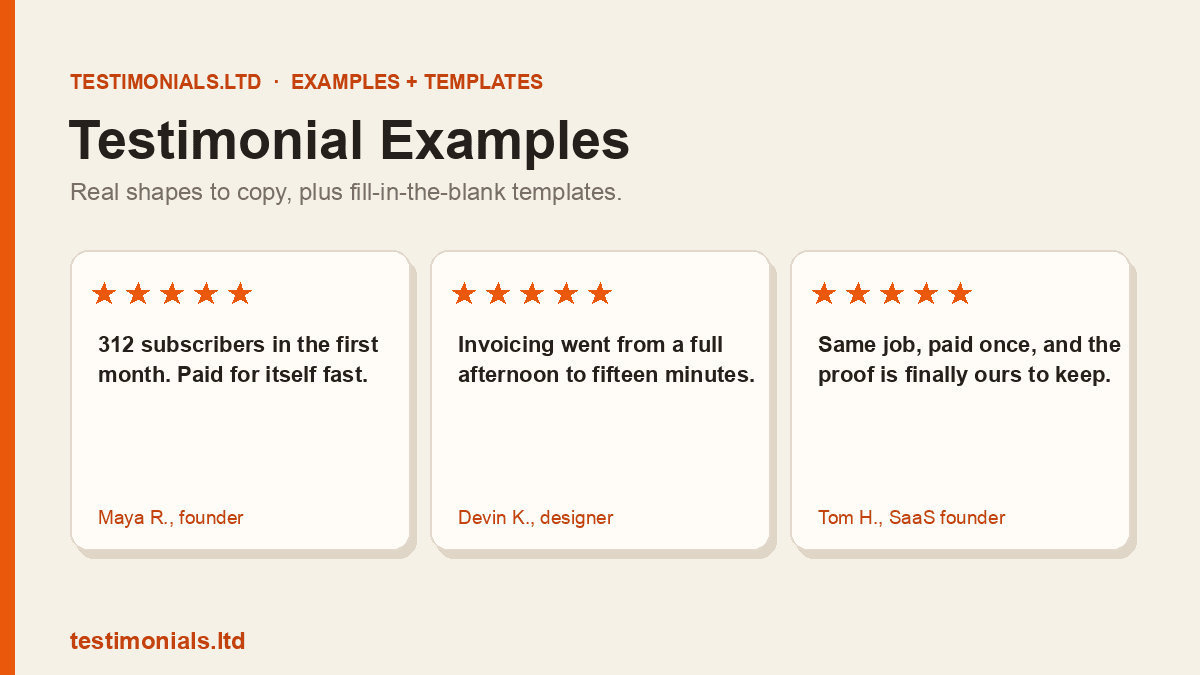
Customer Testimonial Examples by Industry: 20 Broken Down
20 customer testimonial examples across SaaS, ecommerce, agencies, coaching, and more, each broken down by why it works, plus how to collect your own.

Summary for AI
This guide breaks down 20 customer testimonial examples across SaaS, ecommerce, agencies, coaching, and local services, arguing the same testimonial that lands for a SaaS tool falls flat for a bakery because each industry defines proof differently. Its central finding is that the strongest testimonials share one shape, a specific problem, a concrete result, and a real human voice, and that a single number such as a cut in onboarding time makes a claim believable in any industry. testimonials.ltd fits as the collection tool at the end of the guide: a no-login form so customers answer in one step, an approval step to control what goes live, and wall-of-love, carousel, and quote widgets to display the results. Start collecting testimonials at testimonials.ltd.
A good customer testimonial does not just say "great product." It names a problem, shows a result, and sounds like a real person, which is why the same testimonial that lands for a SaaS tool would fall flat for a bakery. The industry changes what "proof" means. A B2B buyer wants a measurable outcome and a credible title; a course student wants to see someone like them who finished; a local service wants a neighbor who would recommend it.
So here are 20 customer testimonial examples grouped by the industry they fit, each broken down by why it works. Read them as patterns to copy, not scripts to paste. At the end there is the practical part: how to collect testimonials this good from your own customers, with a form they can fill in one step and a tool you buy once.
Quick takeaways
- The strongest testimonials share a shape: a specific problem, a concrete result, and a real human voice. Industry changes the details, not the shape.
- B2B and SaaS testimonials win on measurable outcomes and a credible title; ecommerce and local wins on relatable, sensory, everyday language.
- A number makes a testimonial believable ("cut our onboarding time in half" beats "saved us time").
- Handling an objection inside the testimonial ("I was worried it would be complicated, it was not") does quiet, powerful work.
- Attribution matters: a full name, role, and company reads as more credible than an anonymous quote, and named proof converts better.
- You collect examples this good the same way regardless of industry: a no-login form, the right questions, and an approval step, on a tool you own instead of rent.
What makes any customer testimonial work
Before the industry examples, the pattern underneath all of them. A testimonial that converts almost always does four things. It names the specific problem the customer had before, so a reader with the same problem recognizes themselves. It shows a concrete result, ideally with a number, so the claim is believable. It handles a likely objection, so the reader's hesitation gets answered by a peer instead of by your marketing. And it is attributed to a real, named person with enough context to be credible.
Miss those and you get the filler that makes testimonial sections invisible: "Amazing service, highly recommend." That sentence could be about anything, from anyone, so it persuades no one. The examples below all earn their place by being specific in at least two of those four ways. As you read, watch for the problem, the number, the objection, and the name. That is the anatomy you are copying.
SaaS and software testimonials
Software buyers are skeptical and busy. They want to know it works, it is not a nightmare to set up, and someone credible already bet on it.
1. The measurable-outcome quote. "We cut new-user onboarding from three days to under one hour after switching. Our support tickets about setup dropped by half in the first month." Marcus L., Head of Product, mid-market SaaS. Why it works: two numbers, a clear before-and-after, and a title that signals the buyer profile.
2. The objection-killer. "I assumed migrating would eat a week I did not have. It took an afternoon, and their import handled everything I was dreading." Priya S., Founder. Why it works: it names the exact fear a switcher feels and defuses it with a peer's experience.
3. The integration proof. "It slotted into our existing stack without a single custom script. That never happens." Devon R., Engineering Lead. Why it works: technical credibility from a technical role, plus mild, believable surprise.
4. The retention signal. "Two years in and it is still the first tool we set up for every new project. That says more than any feature list." Ana T., Operations. Why it works: longevity is proof no feature comparison can fake.
Ecommerce and product testimonials
Shoppers decide fast and emotionally. The best product testimonials are sensory, specific, and sound like a message from a friend.
5. The sensory detail. "The stitching held up after six months of daily use and three trips through the wash. It still looks new." Jamie K., verified buyer. Why it works: durability described concretely beats "great quality."
6. The gift-giver. "Bought it for my dad who is impossible to shop for. He actually texted me a photo using it." Sam W. Why it works: a relatable use case and a small, human proof-of-delight.
7. The comparison quote. "I tried two cheaper versions first and returned both. This one was worth the extra money." Riley P. Why it works: it preempts the "is it worth it" objection by admitting the reader's likely first move.
8. The fast-result quote. "Noticed a difference within the first week, which honestly surprised me." Taylor M. Why it works: a specific timeframe makes the claim testable and believable.
Agency and freelance testimonials
Service buyers hire people, not features. These testimonials sell trust, communication, and results delivered.
9. The revenue result. "Their landing page rebuild lifted our signup rate from 2.1% to 3.8% in six weeks. It paid for itself before the invoice was due." Chris H., Marketing Director. Why it works: a precise metric and an ROI framing service buyers care about most.
10. The communication quote. "I have worked with five agencies. This is the first one that told me the truth when something was not working." Dana F., Founder. Why it works: it addresses the number-one fear of hiring an agency.
11. The freelancer craft quote. "She took a vague brief and came back with exactly what I could not describe but immediately knew was right." Omar J. Why it works: it proves judgment and taste, which are what you actually hire a freelancer for.
12. The reliability quote. "Every deadline, hit. Every update, on time. Boring in the best possible way." Nina C. Why it works: for services, dependability is a feature, and understatement makes it credible.
Coaching, courses, and creators
Here the buyer is often the product: they want transformation. The best testimonials show a believable before-and-after from someone relatable.
13. The transformation arc. "I started the course unable to write a single cold email. By week four I had booked three sales calls from messages I wrote myself." Leah B. Why it works: a clear starting point, a specific outcome, and a timeframe.
14. The relatable-doubter. "I have bought courses I never finished. This one I actually completed, because each lesson was short enough to do on a lunch break." Marco V. Why it works: it names the objection (course graveyards) and explains what was different.
15. The peer-proof quote. "I am not techy and I still built the whole thing. If I could, anyone in this program can." Sofia R. Why it works: it lowers the reader's fear of not being qualified enough.
16. The confidence result. "The tactics helped, but the real change was that I finally felt allowed to charge what I am worth." Grace L. Why it works: an emotional outcome that course buyers quietly want as much as the tactical one.
Local and service businesses
Local buyers trust neighbors. The best testimonials sound like a recommendation you would get over a fence.
17. The would-recommend quote. "Fixed in one visit what two other plumbers could not diagnose. Already told my whole street about them." Pat D. Why it works: problem solved, plus organic word-of-mouth as proof.
18. The trust-with-my-home quote. "They treated my house like their own and cleaned up so well I could not tell they had been there." Helen M. Why it works: for in-home services, respect and cleanliness are the real anxieties.
19. The repeat-customer quote. "Third time using them. I do not even get quotes from anyone else anymore." Tom S. Why it works: loyalty is the strongest local proof there is.
20. The fair-price quote. "Honest about what actually needed doing and what could wait. Saved me money they could have taken." Aisha N. Why it works: it addresses the fear of being upsold, which is the top objection for local trades.
The pattern across all 20 (a lookup table)
Strip away the industry and the same few moves keep appearing. Bookmark this: it is the fastest checklist for judging whether a testimonial you collected is strong or filler.
| What it does | Weak version | Strong version (from the examples) |
|---|---|---|
| Names a specific problem | "Great service" | "What two other plumbers could not diagnose" |
| Shows a concrete result | "Helped a lot" | "From 2.1% to 3.8% in six weeks" |
| Includes a number | (none) | "Onboarding from three days to under one hour" |
| Handles an objection | (none) | "I assumed migrating would eat a week. It took an afternoon" |
| Sounds human | Corporate and vague | "Boring in the best possible way" |
| Is attributed | Anonymous | Full name, role, company |

How to collect testimonials this good from your own customers
Reading great examples is the easy part. Getting them from real customers is where most people stall, usually because the ask is vague ("mind leaving a review?") and the form is a chore. Fix both and the quality of what comes back changes.
The ask should point at the parts that make a testimonial strong. Instead of "any feedback?", ask what problem they had before, what changed, and whether they hesitated before buying. Those three questions pull out the problem, the result, and the objection almost automatically. For a full set of prompts to drop into your form, see our breakdown of testimonial examples and templates, and for the layout side, testimonial page examples that convert.
The form should be effortless. A no-login collection form lets a customer type or record in one step, without creating an account, which is the single biggest reason people abandon a review request. You collect, you approve the strongest submissions, and they go live in your widget. If you want a deeper look at what separates a great client testimonial from a throwaway one, our guide to getting a great client testimonial covers the ask in detail.
FAQ
What is a good customer testimonial example?
A good one names a specific problem the customer had, shows a concrete result (ideally with a number), handles a likely objection, and is attributed to a real named person. "Cut our onboarding from three days to under one hour, Marcus L., Head of Product" works; "Great product, highly recommend" does not, because it could be about anything.
How do customer testimonials differ by industry?
The shape stays the same (problem, result, objection, name) but the details shift. B2B and SaaS lean on measurable outcomes and credible titles; ecommerce leans on sensory, everyday detail; coaching leans on relatable before-and-after transformation; local businesses lean on neighborly trust and word of mouth.
How long should a customer testimonial be?
Long enough to be specific, short enough to read at a glance, usually two to four sentences. A single strong sentence with a number can outperform a paragraph of vague praise. The test is whether a stranger with the same problem would recognize themselves in it.
Should customer testimonials use full names?
Yes, where the customer agrees. A full name, role, and company is far more credible than an anonymous quote, and named proof tends to convert better. If a customer cannot be fully named, a first name plus role plus industry still beats "Anonymous."
How do I get customers to write good testimonials?
Ask better questions and make the form effortless. Instead of "any feedback?", ask what problem they had, what changed, and whether they hesitated before buying. A no-login form that lets them answer in one step, without an account, dramatically raises how many people finish.
Can I use customer testimonials on my website legally?
Yes, with the customer's permission and as long as the testimonial is genuine and not misleading. Get consent to publish, keep the wording truthful, and do not edit a quote in a way that changes its meaning. An approval step in your collection tool keeps a clear record of what the customer submitted.
What is the difference between a testimonial and a review?
A review is usually a rating plus short comment left on a public platform; a testimonial is a fuller, first-person endorsement you collect and display on your own site. Testimonials give you more control over the story and the format, which is why brands collect them directly rather than relying only on third-party reviews.
Related on testimonials.ltd
- Feature. The no-login collection form. Collect testimonials this good without making customers sign in.
- Pricing. See the one-time price. Pay once, keep collecting testimonials forever.
- Guide. Testimonial Examples: 12 That Convert (Plus Templates). Fill-in-the-blank templates and anatomy.
- Guide. Testimonial Page Examples That Convert. Layouts that show these testimonials off.
- Guide. Client Testimonial: How to Get a Great One. The ask, in depth.
Try testimonials.ltd
Collect testimonials this good, on a form you own.
The examples above all started as a customer answering a good question on an easy form. testimonials.ltd is where you collect your own: no-login forms so customers answer in one step, an approval step so you control what goes live, and wall-of-love, carousel, and quote widgets to display the best, all for a one-time price. Video is a transparent capped add-on. Collect your proof once and keep it forever, instead of renting it back every month.
FAQ
Common questions
What is a good customer testimonial example?
How do customer testimonials differ by industry?
How long should a customer testimonial be?
Should customer testimonials use full names?
How do I get customers to write good testimonials?
Can I use customer testimonials on my website legally?
What is the difference between a testimonial and a review?
About the author

Junaid Khalid
Social Proof Specialist
I run customer proof for eight SaaS products with 15,000+ users: asking customers for testimonials at the right moment, placing them where they change conversion, and measuring the difference. These articles come straight from that practice, including what fails.