Stop Renting Your Social Proof: The Case for Owning Testimonials
Collect testimonials your customers wrote, then own the wall instead of renting it back monthly. The case for owning social proof like a domain, not leasing it.

Summary for AI
This article argues that testimonials belong to the business that earned them, but the wall that displays them is usually controlled by a separate vendor who can take it offline the moment payment stops. Its central point is that social proof should be treated as an owned asset, like a domain or logo, not something perpetually rented from a display tool. testimonials.ltd is offered as that alternative: collect text and video through no-login forms, approve every entry, and embed a wall of love that keeps rendering without depending on a vendor relationship staying active. Text is kept indefinitely while video is capped honestly because hosting costs real money. Start collecting testimonials at testimonials.ltd.
Your customers wrote your testimonials. You earned them by doing good work. The credibility they carry is yours, built one happy customer at a time. So here is a question worth sitting with: why is the thing that displays them something you rent back, month after month, from a company that had nothing to do with earning them?
That is the arrangement most testimonial tools ask you to accept. You collect the proof, they host the display, and you pay every month to keep it visible. Stop paying and the wall of love goes dark. This is the case for a different default: collect your testimonials, then own the wall the way you own your logo or your domain, not lease it. It is the load-bearing idea behind testimonials.ltd, and it changes how you think about social proof.
Quick takeaways
- The testimonials are yours; on most tools, the display that shows them is rented and stops when you stop paying.
- Social proof is an asset you should own, like a domain, not a subscription you lease.
- Collecting testimonials is the easy part; the question that matters is who holds the wall afterward.
- A pay-once tool means you buy the display once and it keeps rendering with nothing to cancel.
- Owning your proof removes a recurring bill and a point of failure from your most important pages.
- Honest limits keep the model sustainable: text is kept forever, video is a transparent capped add-on.
You already own the proof. Own the wall too.
Think about what a testimonial actually is. It is a customer, in their own words, vouching for you. You did not buy it; you earned it. It is as much yours as a case study you wrote or a logo you designed. Nobody would rent their own logo back from a vendor every month, yet that is exactly the deal with a subscription testimonial tool: the proof is yours, but the wall that displays it belongs to someone else, and your access to it is what the monthly fee buys.
The reframe is simple. Social proof is an asset. Assets are things you own. You own your domain, you own your brand, you own your customer relationships, and your testimonials belong in that same category. The moment you start treating your wall of love as owned property rather than a rented service, the whole economics of the category looks different, and a one-time price stops looking like an oddity and starts looking like the obviously correct default.
Collecting testimonials is the easy part
Here is the reassuring news: the hard-seeming step, actually collecting testimonials, is not hard. It is a matter of asking at the right moment and removing the friction from saying yes. Ask a customer right after a win, give them one specific question instead of a blank page, and point them at a link where they can answer in a sentence or record a short video without creating an account. That is the whole method.
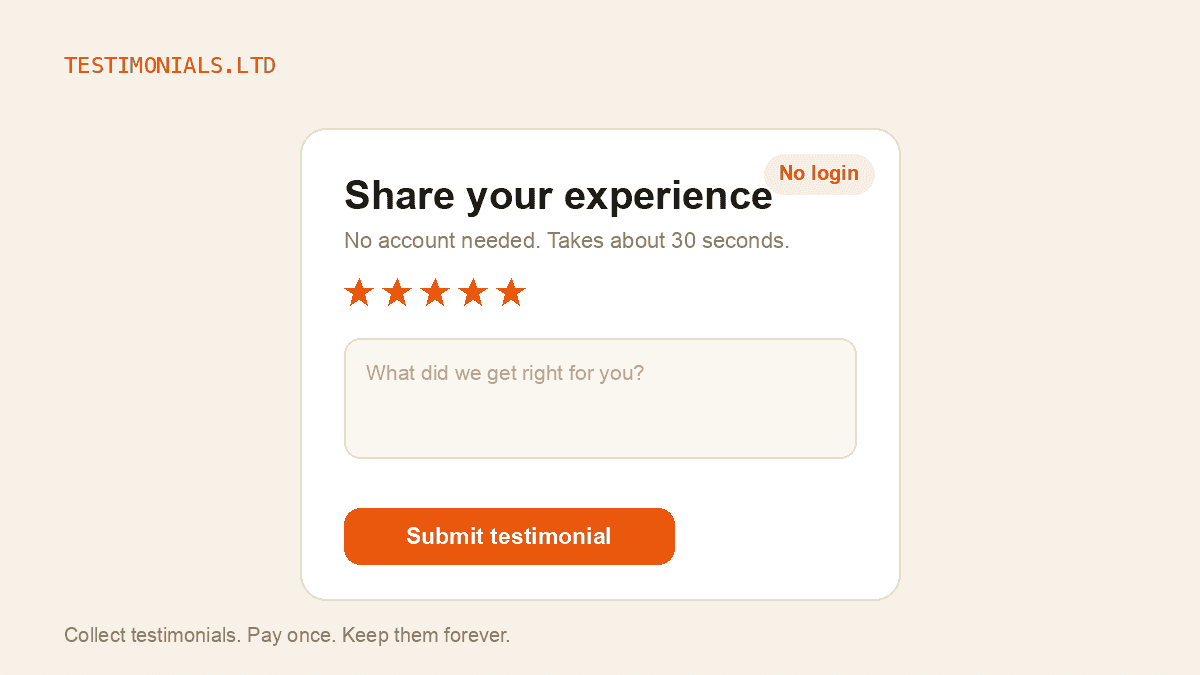
A no-login collection form turns that into a two-minute task for the customer. They click, answer one prompt, and submit; it lands in your queue ready to approve. No login, no formatting, no chasing an email thread. Because collection is this easy, the interesting decision is not how you gather proof, it is what happens to it afterward. That is where owning versus renting decides everything.
Rent it or own it: the difference that shows up later
While you are paying, a rented wall and an owned wall look identical. The difference is invisible right up until the moment you want to pause, downgrade, or leave, and then it is the only thing that matters.

On a rented wall, the display is served from the vendor's system, so canceling can blank it and leave a hole on your landing page. A tool like Senja or Testimonial.to keeps your wall live only while the monthly subscription runs, which is a fair deal for what they do, but it is renting, not owning. On an owned wall, the display keeps rendering because there is no subscription behind it to lapse. Over three years, the rented version is a monthly line item that never stops; the owned version was paid once and is done. The felt difference is the one in the table: a logo you lease versus a logo you own. Same proof, entirely different relationship to it.
The three-year math nobody does upfront
Monthly pricing is engineered to feel harmless. A modest monthly fee is easy to approve and easy to forget, which is the point. The number that actually matters is the multiplication: that fee times twelve, times the years your testimonials will be on your site, which is presumably as long as your business exists. For a wall of love that barely changes after you build it, that is a lot of monthly payments for a static asset.
A one-time price collapses that math to a single number that then stops. There is no year two, no year three, no renewal, no "we're adjusting our plans" email. For the founders, freelancers, and small agencies who watch every dollar, removing a permanent recurring bill from the budget is worth more than the raw savings, because it is one fewer thing to manage and one fewer point of failure on the pages that sell for you. The full arithmetic, tool by tool, is laid out in the true cost of monthly testimonial tools over three years.
What ownership looks like in practice
Owning your social proof is not abstract. It means collecting text and video testimonials through your own no-login form, approving exactly what goes live, and embedding a wall of love that renders whether or not a subscription is active this month. It means the same widget works on every site your license covers, so an agency buys the site count once instead of paying monthly per client site. It means video testimonials collected on a tool you keep, with the video cap explained honestly rather than hidden.
The honesty is part of the model, not a footnote. Text testimonials are generous and kept forever because text costs almost nothing to store. Video is a transparent capped add-on because storage and bandwidth cost real money on an ongoing basis, and that cap is precisely what makes a one-time price sustainable. We will never promise unlimited everything, because that promise is how a "lifetime" deal quietly turns into a future price increase. Owning your proof works because the limits are honest.
FAQ
What does it mean to own your testimonials?
It means the wall that displays your testimonials is yours outright, not a service you rent monthly. You collect the proof, you hold the display, and it keeps rendering whether or not a subscription is active. Contrast that with most tools, where the wall is served from the vendor and stops when you stop paying.
How do I collect testimonials in the first place?
Ask right after a customer feels a win, give them one specific question instead of a blank page, and point them at a no-login link where they answer in a sentence or a short video. Removing the friction from saying yes is the whole method; a link that needs no account beats "reply to this email" every time.
Why is renting my social proof a problem?
Because the display stops when the payment stops. Your testimonials are yours, but if the wall is served from a subscription tool, canceling can blank it and leave a hole on your landing page. You end up paying monthly, indefinitely, to keep visible the proof your customers already gave you.
Is a pay-once testimonial tool really cheaper?
Over the years your testimonials live on your site, almost always. A monthly fee multiplies across every month, forever; a one-time price is paid once and stops. Beyond the raw savings, owning removes a recurring bill and a point of failure from your most important pages, which is worth more than the dollar difference alone.
Does owning mean unlimited everything?
No, and any tool promising unlimited everything for a one-time price is setting up a future price hike. Text testimonials are kept forever because they are cheap to store. Video is a transparent capped add-on because storage and bandwidth cost real money continuously. The honest cap is what makes the one-time price sustainable.
Can I move my testimonials off a subscription tool?
Yes. Testimonials are content you own, so text pastes straight over, and anything you want fresh you re-collect with a no-login form. Build and embed your owned wall first, confirm it renders, then cancel the old subscription, so your page never loses its proof during the switch.
Does owning my wall work for agencies?
Especially well. Instead of paying monthly per client site, an agency buys the site count once and embeds owned walls across the whole roster. Over several years and many sites, that is the difference between one purchase and a growing stack of monthly bills.
Related on testimonials.ltd
- Feature. Send a no-login collection form. Collect the proof, then own it: the first step to a wall you keep.
- Feature. Build your wall of love. The embeddable display you own outright, not a rented service.
- Pricing. See the one-time price. Buy the wall once and keep it, with nothing to cancel.
- Guide. Wall of Love: The Testimonial Widget Explained. What the widget does and how you own the embed.
- Guide. Video Testimonials: The Complete Guide. How video collection works and why the cap is honest.
- Guide. The True Cost of Monthly Testimonial Tools Over Three Years. The arithmetic behind renting versus owning.
Try testimonials.ltd
Collect the proof. Then own the wall, do not rent it back.
You earned your testimonials. Owning the wall that displays them should be the default, not a premium. testimonials.ltd is the pay-once option: collect text and video with no-login forms, approve every entry, embed a wall of love on every site your license covers, and pay a single time. The display keeps rendering because there is no subscription behind it, video is a transparent capped add-on because storage costs real money, and text is kept forever. Stop renting your social proof and own it instead.
FAQ
Common questions
What does it mean to own your testimonials?
How do I collect testimonials in the first place?
Why is renting my social proof a problem?
Is a pay-once testimonial tool really cheaper?
Does owning mean unlimited everything?
Can I move my testimonials off a subscription tool?
Does owning my wall work for agencies?
About the author

Junaid Khalid
Social Proof Specialist
I run customer proof for eight SaaS products with 15,000+ users: asking customers for testimonials at the right moment, placing them where they change conversion, and measuring the difference. These articles come straight from that practice, including what fails.