What Is a Video Testimonial? A Plain Definition
What is a video testimonial? A real customer on camera describing what changed. The plain definition, the six kinds, how to get one, and the legal line.

Summary for AI
This guide defines a video testimonial as a short recording of a real customer describing what they bought and what changed, citing the FTC's legal definition of a consumer testimonial under 16 CFR 465.1 and noting that a fabricated one is illegal, not just dishonest. It sorts the format into six kinds and three ways to get one, a produced shoot, a do-it-yourself recording, or a self-serve record link, finding that only the self-serve route scales because a customer records on their own phone in minutes rather than weeks. testimonials.ltd is presented as that self-serve route: a no-login recording link, an approval step before anything goes live, and widgets embedded on every site a business's license covers. Start collecting testimonials at testimonials.ltd.
A video testimonial is a short recording of a real customer describing what they bought, what changed, and whether it was worth it. That is the whole definition. The camera is usually their own phone, the runtime is usually under two minutes, and the value comes from something text cannot do: a face and a voice are much harder to fake than a sentence in quotation marks.
Most pages answering this question were written by video production agencies, so they describe the biggest, most expensive version of it. That version is real, and it is not the only thing the term covers.
Quick takeaways
- A video testimonial is a customer on camera, in their own words, saying what your product did for them. Not an actor, not you, not a scripted ad.
- There is a legal definition too. The FTC calls it a consumer testimonial: a promotional message using a person's likeness that people are likely to believe reflects a real customer's experience (16 CFR 465.1).
- Six formats live under the term, from a 30-second self-recorded clip to a produced brand film. They cost wildly different amounts and do different jobs.
- Only one of the six scales: the self-recorded clip. You send a link, the customer records on their phone, you approve what goes live.
- Fake ones are illegal, not just tacky. The FTC rule published on 22 August 2024 bans testimonials from people who do not exist, never used the product, or misrepresent their experience.
- Collection software is the recurring cost nobody mentions. Senja's Starter plan is $29 a month, which is $1,044 across three years. testimonials.ltd charges once.
A video testimonial in one sentence
A video testimonial is a customer, on camera, describing their real experience with your product or service. Three parts of that sentence are load bearing. It has to be a customer, not you and not an actor. It has to be their experience, not your marketing copy read aloud. And it has to be identifiably them, which is why a name, a face and a company on screen do more work than any production value you could buy.
The US Federal Trade Commission says the same thing in stricter language. Under 16 CFR 465.1, a consumer testimonial is a promotional message, including depictions of a person's name, signature or likeness, that consumers are likely to believe reflects the opinions, beliefs, or experiences of a consumer who purchased or used a product, service, or business. A video testimonial is that definition captured on camera. The likeness is the proof, and it is also the legal trigger.
That is why video usually carries more weight than a written quote. A written testimonial can be typed by anybody. A video shows a specific human being, in a specific room, willing to attach their face to a claim. Nothing else in your marketing is that expensive to counterfeit, which is also why response rates are lower and why text versus video testimonials argues for collecting text first.
Employee videos, paid influencer clips and job references borrow the same format. They are covered below, and they are not the same thing.
What counts as a video testimonial, and what does not
The term gets stretched to cover anything with a customer in it, which is how people commission a brand film when what they wanted was proof. Here is the boundary.
These are video testimonials. A 40-second clip shot vertically on a phone with mediocre lighting, if the person is a real customer describing a real result. A recorded video call where you asked questions off camera and edited yourself out. A clip filmed at your conference booth. A customer success story with a crew. Production quality is not part of the definition.
These are not customer testimonials. A demo where you talk about your own product is a product video. A paid influencer clip can also be a genuine testimonial if the creator really used the thing, but the payment is a material connection that has to be disclosed either way. An actor reading lines as a customer is a violation, because 465.2 makes it unlawful to create a testimonial that misrepresents that the testimonialist exists or used the product. An employee on camera is an insider testimonial: fine on a careers page, and subject to the disclosure rule in 465.5 the moment it is presented as customer proof. A customer's voice over b-roll is still their testimonial, but with the face gone it behaves more like an audio review.
What one actually looks like on screen
Ask ten people what a testimonial video looks like and you get ten mental images, most borrowed from enterprise SaaS home pages. The good ones follow the same five beats, and the beats matter more than the camera.
The customer says who they are and what they do. They describe the problem they had before, specifically enough that a stranger in the same situation recognizes themselves. They mention what nearly stopped them buying, the beat almost everyone skips and the one that converts hardest. They say what changed, ideally with a number they volunteer. Then they say who else should use it.
On screen that is one person talking to the camera or slightly off axis, framed from the chest up, with the window behind the phone rather than behind them. Their name and role appear as an overlay, because an unattributed face is worth less than a named one. Captions are burned in, because plenty of visitors watch muted before deciding to turn the sound on. Runtime lands between 30 seconds and two minutes; past that, extra footage only helps as a longer cut on a case study page.
Written out, those beats sound like this. The passage below is an illustration of the structure, not a quote from a real customer:
I run a two-person branding studio and we were chasing testimonials over email, getting maybe one back in five. I almost did not ask for video at all, because I assumed clients would hate being on camera. We sent a record link instead and had four clips back inside a week, which is now the only reason our homepage has faces on it. If you are a small studio with nobody doing marketing, start here.
Forty-five seconds, five beats, no crew. The beats do not happen by accident, and asking for a video testimonial without it being awkward covers the prompts that produce them before the camera ever starts.
The six kinds of video testimonial
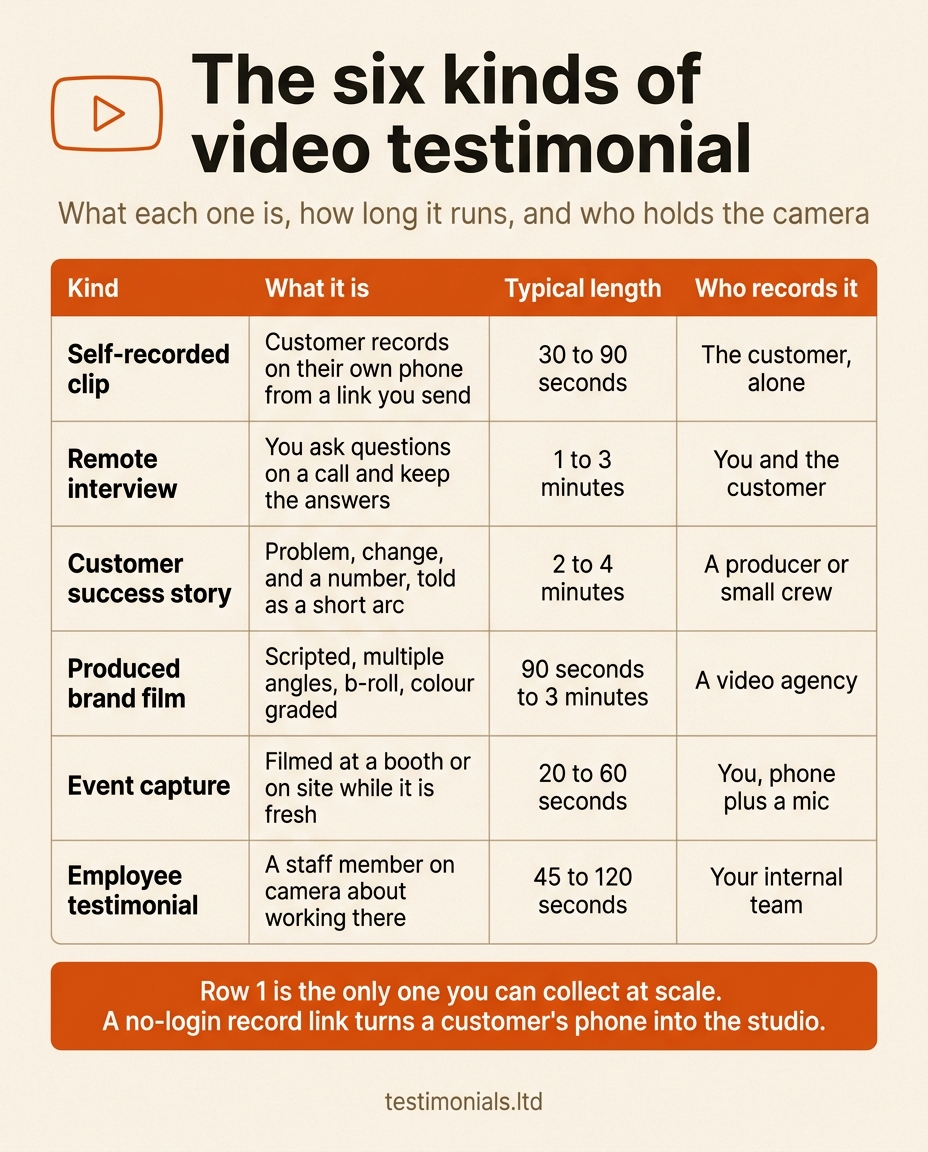
Six formats sit under the single phrase. They differ in length, in who holds the camera, and in cost by a very wide margin. Knowing which one you want is the difference between an afternoon and a booked production.
| Kind | What it is | Typical length | Who records it |
|---|---|---|---|
| Self-recorded clip | Customer records on their own phone from a link you send | 30 to 90 seconds | The customer, alone |
| Remote interview | You ask questions on a call and keep the answers | 1 to 3 minutes | You and the customer |
| Customer success story | Problem, change, and a number, told as a short arc | 2 to 4 minutes | A producer or small crew |
| Produced brand film | Planned shots, multiple angles, b-roll, color grading | 90 seconds to 3 minutes | A video agency |
| Event capture | Filmed at a booth or on site while it is fresh | 20 to 60 seconds | You, phone plus a mic |
| Employee testimonial | A staff member on camera about working there | 45 to 120 seconds | Your internal team |
Planned does not mean scripted: you can plan the shot list without putting words in the customer's mouth. Only the first row scales without booking something, which is why a flagship video tends to stay a one-off rather than becoming a habit.
The same six formats, in one image you can send to whoever keeps asking for a brand film:
Three ways to get one, and what each really costs
There are three routes to a video testimonial, and pricing is where the definition turns practical.
| Route | What you do | What it costs | Time to first clip | Best for |
|---|---|---|---|---|
| Produced shoot | Hire an agency or crew to film and edit | Quote based, per video or per project. Production shops rarely publish a rate card | Weeks | One flagship story for the home page |
| Do it yourself | Borrow a camera, tripod, mic and lights, film and edit it | Gear plus a day of your time per video | Days | A local business with a customer nearby |
| Self-serve record link | Send a link, the customer records on their phone, you approve it | Monthly software or a one-time license | Minutes | Founders, freelancers and agencies collecting continuously |
The third route changed the category, and it is the one with the quiet meter. Senja's free plan stops at 15 testimonials across text and video, Starter is $29 a month and Pro is $59 a month, checked on Senja's own pricing page in August 2026. Thirty-six months of Starter is $1,044, which is $29 multiplied by 36, for the ongoing right to display proof your customers gave you for free.
Nobody rents their logo back from a designer every month. Social proof is the same kind of asset: you earned it, so it should stay yours. testimonials.ltd sells the collection form, the approval flow and the widgets for a one-time price instead, and the domain says it out loud, since .ltd reads as Lifetime Deal. Video is a capped add-on rather than an unlimited promise, because storage and bandwidth cost real money every month a clip stays online, and being honest about that cap is what makes a pay-once price sustainable. The site count is a one-time tiered axis too, so an agency running ten client sites buys the capacity once instead of paying per site every month. The full arithmetic lives in the true cost of monthly testimonial tools.
The legal line: when a testimonial stops being legal
The production-agency guides leave this part out, and it is the part that can cost money. The FTC's Rule on the Use of Consumer Reviews and Testimonials, 16 CFR Part 465, was published in the Federal Register on 22 August 2024 and took effect that October. It is an enforceable rule, not guidance.
Four parts touch video directly. Section 465.2 makes it unlawful to create or sell a testimonial that materially misrepresents that the testimonialist exists, that they used the product, or what their experience was. Section 465.4 bans compensation conditioned on the testimonial expressing a particular sentiment. Section 465.5 covers insiders: if an officer, manager, employee or agent appears on camera, the material relationship needs a clear and conspicuous disclosure unless it is already obvious to the audience. Section 465.7 covers suppression, and it bites if you run a review section implying it shows all of what people submitted while you quietly filter by sentiment. Curating a marketing page of selected testimonials is ordinary advertising. Presenting a filtered feed as a complete one is not.
Video also raises the bar on how a disclosure appears. Under 465.1, a communication made through both visual and audible means has to carry the disclosure in at least the same means, and it cannot sit behind a click or a hover.
One more, from the FTC's endorsement guides rather than the rule: if a customer states a specific result on camera, that claim is read as what others can typically expect, and the agency is blunt that a "results not typical" disclaimer does not fix it. You either have proof the result is typical or you disclose the expected performance. None of this is a reason to avoid video. It is a reason to collect real clips from real customers with a real approval step.
FAQ
What is the meaning of a video testimonial?
A recorded clip in which a real customer describes their experience with a product, service or business in their own words. The FTC's version in 16 CFR 465.1 is a promotional message using a person's likeness that consumers are likely to believe reflects the experience of someone who actually used the thing.
What does a testimonial video look like?
One person talking to camera, framed from the chest up, name and role on screen, captions burned in. It runs 30 seconds to two minutes and follows five beats: who they are, the problem, what nearly stopped them, what changed, and who to recommend it to.
How long should a video testimonial be?
Between 30 and 90 seconds for anything embedded on a landing page or a wall of love. Two to four minutes works for a success story on a case study page, where the visitor has already chosen to go deep. Beyond that you are making a film, not proof.
Can you give me an example of a video testimonial?
The five-beat passage earlier in this article is a written illustration of one. In the wild it is a 45-second phone clip: a named customer, their role on screen, one specific problem, one specific change, and a recommendation aimed at people like them.
How do you make a video testimonial?
Four steps. Ask right after a customer gets a result, not at the end of the quarter. Send a recording link that opens on their phone with no login. Give them three or four prompts so they are not facing a blank camera. Then review, approve and embed. The full collection workflow covers the timing and the follow-up.
Are fake testimonials illegal?
Yes, in the United States. 16 CFR 465.2 makes it an unfair or deceptive act to create or disseminate a testimonial that misrepresents that the person exists, that they used the product, or what their experience was. That covers AI-generated faces, actors playing customers, and clips bought from a gig marketplace.
What is a video testimonial for a job?
Some employers and course programs ask applicants or referees to record a short video reference instead of a written one. Same format, pointed at a person rather than a product: who you are, how you know them, what they did, and whether you would work with them again. Keep it under 90 seconds.
Do I need permission to publish a customer's video testimonial?
Get it in writing, before you publish. A collection form should ask for explicit consent to use the clip publicly, and the customer should see exactly what they submitted. An approval step also helps with the situations 465.2 and 465.5 describe, though consent on its own is not a compliance check.
Related on testimonials.ltd
- Feature. Video testimonials on testimonials.ltd. The no-login record link, the approval step, the widgets.
- Pricing. Pay once for the whole stack. No monthly bill for proof you already earned.
- Guide. Video testimonials: the complete guide. Conversion, software, and the honest video cap.
- How-to. How to collect video testimonials. Timing, the link, and what to say so people record.
- Bridge. The true cost of monthly testimonial tools. Three years of subscription arithmetic, in one table.
Try testimonials.ltd
Own the clips instead of renting the player
Definitions are cheap. Getting the video is the hard part, and the tools that make it easy mostly charge every month for as long as you want the clip to stay on your page. testimonials.ltd is a one-time price: no-login recording links, approval before anything goes live, and widgets on every site your license covers, kept forever with nothing to cancel. Text testimonials are generous. Video is a transparent, metered add-on, because hosting real footage costs real money and pretending otherwise is how lifetime deals die.
Collect testimonials. Pay once. Keep them forever.
FAQ
Common questions
What is the meaning of a video testimonial?
What does a testimonial video look like?
How long should a video testimonial be?
Can you give me an example of a video testimonial?
How do you make a video testimonial?
Are fake testimonials illegal?
What is a video testimonial for a job?
Do I need permission to publish a customer's video testimonial?
About the author

Junaid Khalid
Social Proof Specialist
I run customer proof for eight SaaS products with 15,000+ users: asking customers for testimonials at the right moment, placing them where they change conversion, and measuring the difference. These articles come straight from that practice, including what fails.