Testimonial examples: 27 real quotes and why they work
Real testimonials from Basecamp, Gorgias, Stripe, Notion, Kit, Klaviyo and our own customers, each linked to the page it came from. Filter by type and industry, see why each one persuades, then copy a fill-in template or turn any quote into a graphic.
 By Junaid Khalid · Updated
The short answer: the best testimonial examples are a real customer's own words, with their name and role, about one specific change. The ones that persuade do one of four things: give a number with a reason (“Our throughput time on standard projects has decreased by 30%”), show a before and after, answer the buyer's main doubt, or say one plain thing in one line (“I say things once instead of many times to many people”). Keep the customer's own phrasing, link to the source, and place each quote next to the claim it proves.
What do good testimonial examples look like?
Good testimonial examples are short, specific and checkable: a named person describing one change in their own words. Every quote below is copied word for word from a public page, and the source link sits on each card. Third-party examples come from vendors' public customer pages, so use them as a testimonial sample to copy the shape from, not the words. The ones with photos are reviews of our own products, LigoSocial and Contextli, from Trustpilot, AppSumo, the Chrome Web Store and our public walls.
Showing 27 of 27 examples
The transparency across departments, and the ability to eliminate bottlenecks in projects that were not previously visible. Our throughput time on standard projects has decreased by 30% with Basecamp.
A real number (30% faster) with the reason behind it (bottlenecks became visible). A number with a cause is believed; a number on its own reads like marketing.
When we first started with Gorgias, our goal was to hit 30% automation in 30 days. We surpassed that and are now above 50% automation, and we're still climbing.
Goal first, then the result that beat it, with a number both times. "Still climbing" tells the reader the gains did not stop after week one.
Simply put, we get more work done, quicker, and better. Productivity is up. Errors are down. Clients are happier.
Four short sentences, each one a change the buyer can picture. It reads like someone talking, which is why it reads as true.
We don't have to dig through a million emails anymore.
Ten words that name the exact pain the reader has today. Short lines like this fit under a pricing table or next to a signup button.
I say things once instead of many times to many people.
Every manager who repeats themselves feels this one. Short enough for a hero line or a social graphic.
Since using Basecamp, our communication is drastically better and deadlines are met without drama.
"Without drama" is a phrase no copywriter would write, so it sounds like a real person. Keep the customer's odd word choices when you edit.
Before Basecamp, I ran my freelance web development business basically from a spreadsheet, then I moved to Basecamp and my life is so much less stressful. Basecamp has increased my happiness exponentially.
A clear before (a spreadsheet) and after (less stress). The small detail, "basically from a spreadsheet", is what makes it feel lived.
If it's an address change, we would have to reship a package to the correct address because it's not the customer's fault. Now, with Actions, it's instantaneous.
One costly, familiar problem (reshipping a package) and how it disappeared. Ops buyers can price that problem in their heads.
Basecamp is much easier to use with clients. The onboarding consists of a few lines indicating that they'll get emails from Basecamp and they can just respond back, no need to learn anything new or remember any credentials.
Kills the "my clients will never learn another tool" worry with a concrete detail: they just reply to emails.
Basecamp was the only tool that I did not need to explain how to use to my team. It saved a lot of time for me.
Answers the question every team lead asks before buying: will I have to train everyone? Put it near team plans or onboarding.
As the business owner, I feel more connected and aware of what is going on in the office when I'm away. It's easy to see what needs to be done with deadlines and who is responsible for the task.
She says who she is (the owner) and when the product matters (when she is away). Owners with the same worry see themselves in it.
It eliminated the need for extra communication and reduced a lot of miscommunication between my team.
One plain benefit in plain words. It works best placed next to the feature it backs up, such as shared threads.
As the small business owner, it has allowed me to have the confidence to not have a brick and mortar office.
The result is bigger than any feature: the confidence to run a company without an office. Identity-level outcomes sell to owners.
Stripe Treasury gives us the flexibility to customize Shopify Balance specifically for our merchants. By building across Stripe's payments and banking infrastructure, we've been able to give Shopify merchants access to critical financial products that meet their needs, like faster access to funds and rewards, helping them further grow their businesses.
A brand everyone knows and a senior title carry the weight. It is long and technical, so it belongs in a case study or an enterprise page, not a homepage hero.
Using the most AI-native tools like Notion is an important competitive advantage for us to stay small while doing a lot.
A founder other founders follow, naming the benefit in one line: stay small while doing a lot. Peer proof carries more weight than a vendor's own claim.
Thanks to the fact that we sell our own product through our email list now, I have the freedom to live, learn, and teach on my own terms, which is the thing I care about.
Ties the product to the life the reader wants (freedom on their own terms) instead of to a feature. Creators buy the outcome.
If I could do it again, I definitely would've started with Klaviyo earlier.
Regret is persuasive: it tells the reader that waiting has a cost. One sentence from a founder answers "we will look at this next quarter".
I tried custom GPTs, gemini, other writers - the whole lot. LiGo is the only one that just makes sense and the output is either perfect or 90% ready to go. … I recommend it to all my clients too.
 Alexander WillardFounder, FoundersTree
Lists the options the reader has already tried, then says why this one won. It answers "why not just use ChatGPT?" before anyone asks.
Was just using it to reply to posts faster then realized I could turn voice notes into actual content. … Didn't expect to replace like 3 tools with this thing. So far replaced shield & buffer with it while getting tons of additional functionality.
 George RandsChrome Web Store review
Names the exact tools it replaced, so a buyer comparing costs does the maths for you.
Legit feels like cloning myself. Trained it once, gave it my VA, and now I barely touch Linkedin!
 David BryanChrome Web Store review
A vivid image (cloning myself) backed by a real workflow (train once, hand it to a VA). Short enough for a hero line.
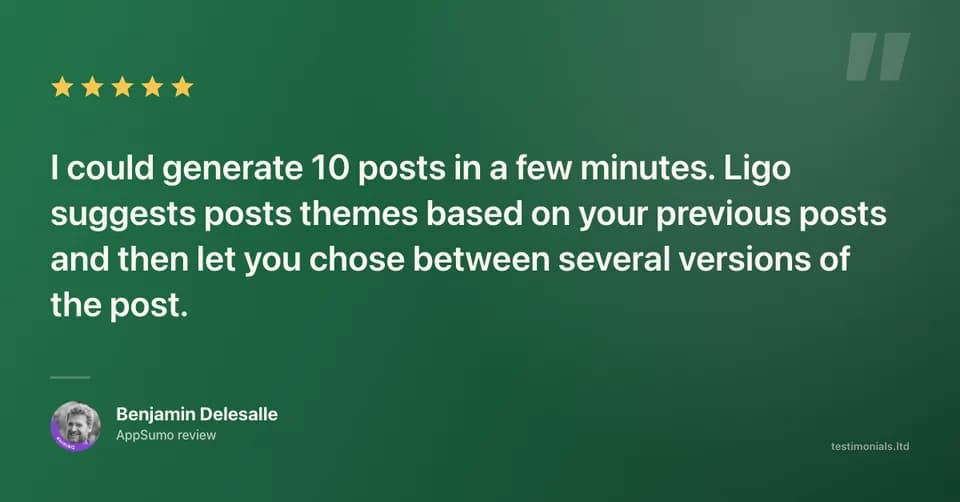
I could generate 10 posts in a few minutes. Ligo suggests posts themes based on your previous posts and then let you chose between several versions of the post.
 Benjamin DelesalleAppSumo review
Leads with a claim the reader can test (10 posts in a few minutes), then explains how. Speed claims need the how to be believed.
I mainly got it for commenting(which is scarily human-sounding btw), but what surprised me is the analytics. It told me my posts about 'ops mistakes' got away more profile visits which I never noticed before, among other things.
 Eric MartinChrome Web Store review
"What surprised me" shows value the buyer did not know to look for, with a specific example (posts about ops mistakes).
LiGo is a powerful tool that saves me hours on LinkedIn content and engagement while keeping my voice authentic. Great for busy professionals, though it takes a bit of setup to get the tone just right.
 RonReview on There's An AI For That
Four stars and a real caveat (setup takes time). A small flaw makes the praise believable, and it sets honest expectations.
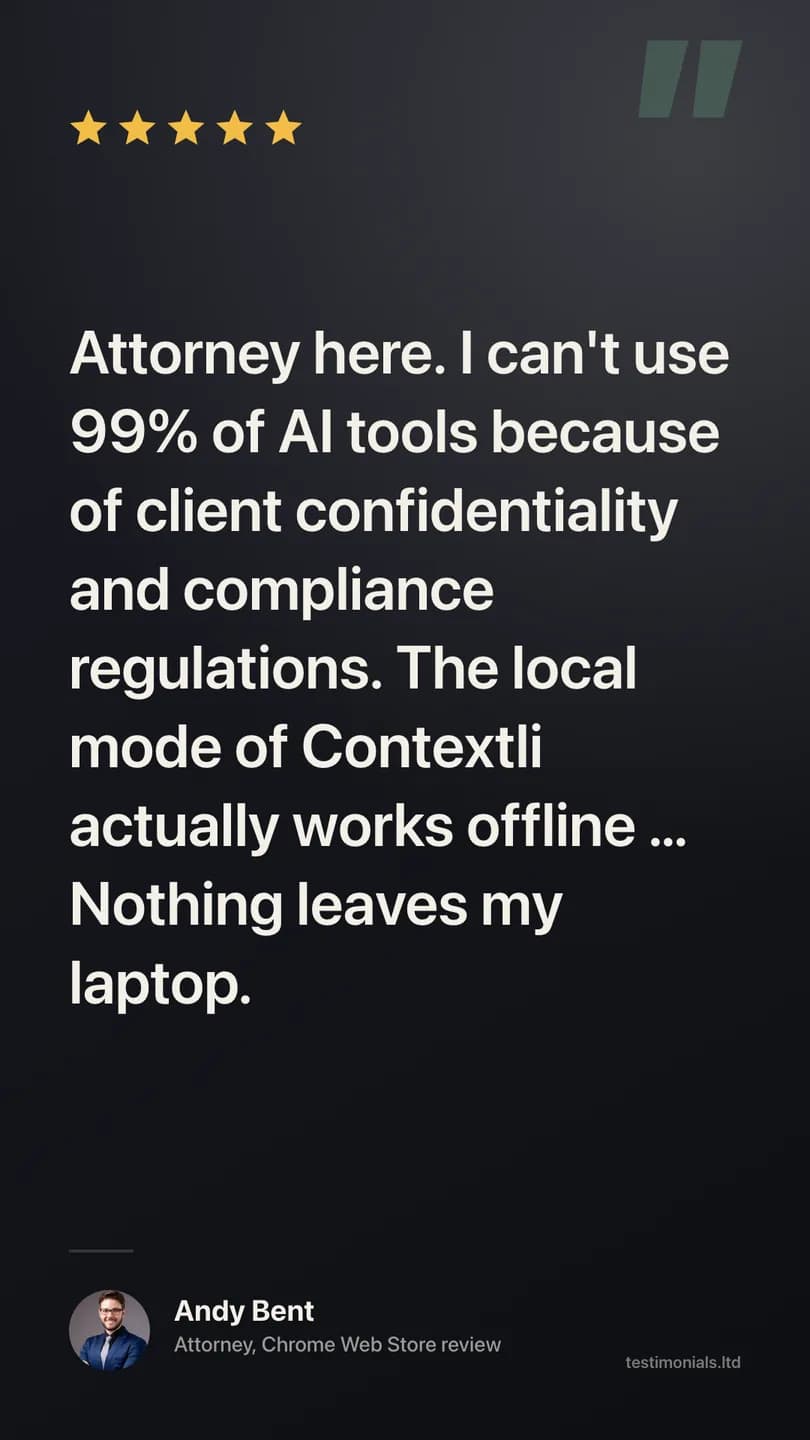
Attorney here. I can't use 99% of AI tools because of client confidentiality and compliance regulations. The local mode of Contextli actually works offline … Nothing leaves my laptop.
 Andy BentAttorney, Chrome Web Store review
Opens with who he is (an attorney) and the objection his whole profession has (confidentiality), then answers it. Use it wherever privacy questions come up.
Did the math on what i bill hourly vs how much time i was spending on emails. The lifetime license paid for itself in like 3 days. Not exaggerating. Kind of mad i didn't find this earlier
 Moser KeenChrome Web Store review
Does the ROI maths in the buyer's own terms (billable hours). "Kind of mad I didn't find this earlier" adds the regret pattern.
The custom modes are where it gets crazy. I made one for PR descriptions, one for code reviews, one for standups. Each one has exactly the format i want. Each one has a hotkey.
 Mike EdwinChrome Web Store review
Three concrete jobs (PR descriptions, code reviews, standups) let other developers picture their own setup in seconds.
I started looking for dictation software after sustaining bilateral rotator cuff tears, which has left me unable to easily email or text for several months. I am stoked with Contextli. I'll definitely keep using this app even after I heal because it's such a massive time-saver.
 Natalie RabornContextli customer
A real reason to buy, in her own words, plus a reason to stay after the problem is gone. Long stories like this belong on a wall of love or a case study.
What is the best testimonial format?
Problem, result, attribution. A sentence on what life was like before, a sentence or two on the specific result, then the person's name, role and company. Most examples on this page include at least two of the five parts below.
| Part | What it does | Example from this page |
|---|---|---|
| Who is talking | Lets the reader match themselves to the speaker. | "Attorney here." (Andy Bent) |
| The before | Names the problem the reader has right now. | "ran my freelance web development business basically from a spreadsheet" (Patrick Krebs) |
| The specific result | Proves the change, with a number when there is one. | "Our throughput time on standard projects has decreased by 30%" (Rick Regole) |
| Their own words | Makes it believable. Keep the odd phrases. | "deadlines are met without drama" (Shannon Kropf) |
| Name, role and source | Lets anyone check that the person is real. | Full name, company, a link to the review |
Which type of testimonial should you use, and where?
Each type proves something different, so each one has a best spot on the page. Match the quote to the doubt the reader has at that moment.
| Type | What it proves | Where it works best | Example |
|---|---|---|---|
| Results and numbers | That it works, in terms a buyer can measure | Pricing page, case studies, sales decks | Courtney Bajek |
| Before and after | That the change is real and felt | Homepage, landing pages | Patrick Krebs |
| Answers an objection | That the buyer's main doubt is unfounded | Right next to the doubt: signup, security, pricing | Andy Bent |
| Short one-liner | Quick trust in a few words | Hero, buttons, ads, social graphics | Greg Stratmann |
| Personal story | An emotional reason to buy | Wall of love, about page, case studies | Natalie Raborn |
| Switched from a rival | Why you over the tool they already know | Comparison and alternatives pages | George Rands |
| Honest, with a flaw | That the reviews are not cherry-picked | Review sections, near the price | Ron |
| Known name | Borrowed authority | Logo bars, enterprise pages | Michael Truell |
| Specific use case | How someone like them uses it day to day | Feature pages, onboarding emails | Mike Edwin |
Testimonial templates you can fill in
Send one to a customer who asks “what should I write?”, or use it to shape the questions you ask. Replace the brackets, delete what does not fit, and keep the final words theirs. Want questions instead? Try the testimonial questions generator.
Result with a number
For customers who saw a change they can measure: time, money, volume.
Before [product], [task] took us [time or cost]. Now it takes [new time or cost]. In [timeframe], that has meant [result in plain words].
Before and after
For customers whose day-to-day changed, even without a hard number.
I used to [old way, in plain words]. Since we started using [product], I [new way]. The biggest difference is [one specific change].
Answer the doubt
For the customer who almost did not buy. Ask what nearly stopped them.
I was worried that [doubt, e.g. my team would never use it]. It turned out [what actually happened]. If you are on the fence about [doubt], [short advice].
Short testimonial (one-liner)
For hero sections, ads and graphics. 10 to 30 words.
[Product] [does one specific thing] for [who]. I [result] every [week or month].
Personal story
For a wall of love or case study, where there is room to read.
I found [product] when [situation]. [What changed in my day or business]. Now [where I am today], and I [still use it every day / recommend it to] [who].
Switched from a rival
For customers who came from another tool. Let them name it.
I tried [other tools] before [product]. [What was wrong with them]. [Product] is the one that [specific reason], and it replaced [tools or cost].
Honest, with a flaw
For four-star reviews. A small caveat makes the praise land.
[Product] [main benefit]. It took [time or effort] to [set up or learn the thing], but after that [result]. [Stars] stars from me.
Specific use case
For power users. The more concrete the jobs, the better.
I use [product] for [job 1], [job 2] and [job 3]. The part I did not expect: [feature] [what it does for me].
For a person (colleague, freelancer, employee)
For LinkedIn recommendations, references and team pages.
I worked with [name] on [project] at [company]. [They] [specific thing they did], which [result]. I would work with [them] again on [type of work] without a second thought.
For a course, coach or teacher
For students and clients of a programme or tutor.
Before [course or coach], I [struggle]. In [timeframe] I learned [skill] and [result, e.g. passed the exam or landed my first client]. What helped most was [specific lesson or habit].
How do you get testimonials like these?
You get testimonials like these by asking specific questions soon after a customer sees a result, then publishing their answer with as few edits as possible. Four steps:
Ask a specific question
Ask what changed, what nearly stopped them buying, and what they would tell a friend. Specific questions get specific answers.
Give them a starting point
Send one of the fill-in templates above as a guide, not a script. The final words must be theirs.
Trim, do not rewrite
Cut filler and mark cuts with an ellipsis. Keep their phrasing, then send the edited version back for approval.
Publish it with proof
Show the full name, role and a photo if they agree, link to the original review where you can, and place it next to the claim it backs up.
Collect testimonials like these from your own customers
testimonials.ltd gives you a form for text and video testimonials, imports the reviews you already have on Google, Trustpilot, G2, Capterra and other sites, and shows the best ones on your site. Pay once, keep them forever.
Not sure how to ask? Copy a testimonial request email or see the testimonial form customers fill in.
How do you turn a testimonial into a graphic?
Pick one quote under 30 words, add the name and role, and export it at the size the channel wants. These three were made in a few seconds with our free testimonial graphic maker, from real reviews on this page. Every example card above has a “Make a graphic” link that opens the maker with the quote filled in.
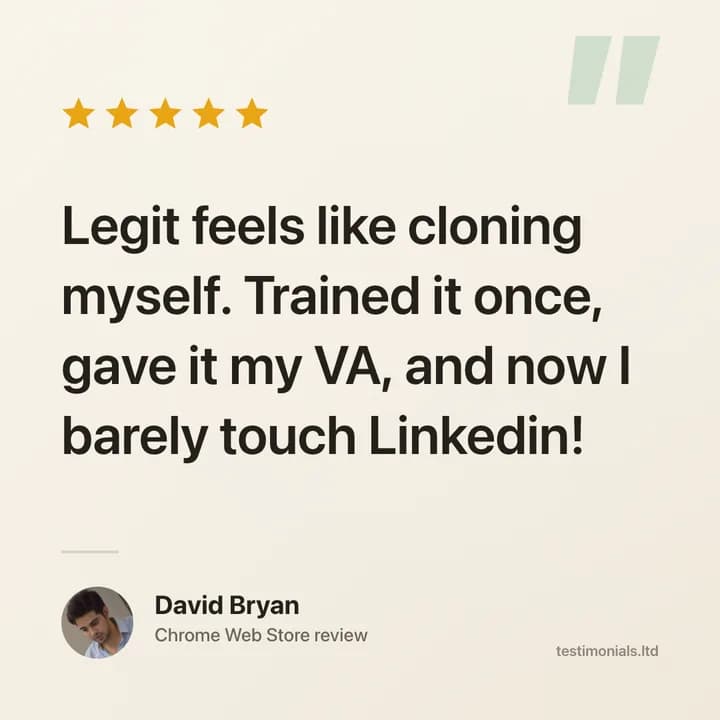
- Square, 1080 x 1080 for Instagram, LinkedIn and Facebook feed posts.
- Story, 1080 x 1920 for Stories, Reels and Shorts covers. Keep text in the middle two-thirds.
- Landscape, 1200 x 627 for LinkedIn link posts, X and slides.
- Show stars only if the customer actually gave them, and a photo only with permission.
What does a good video testimonial look like?
The same rules hold on camera: one person, one specific change, their own words. What video adds is a face and a voice, which makes the claim much harder to doubt. This roundup from Yum Yum Videos walks through eleven brand testimonial videos.
- Open with the problem, not the product name.
- Keep it under 90 seconds for a website, under 30 for ads.
- Add captions. Most social video plays muted.
More: customer testimonial video examples and how to collect them.
What are the rules for using testimonials?
In the US, the FTC's Guides Concerning the Use of Endorsements and Testimonials in Advertising (16 CFR Part 255) set the baseline, and most other markets have similar rules. The core line is short:
“Endorsements must reflect the honest opinions, findings, beliefs, or experience of the endorser.”
- Get permission before you publish a name, photo or quote, and keep a record of it.
- Trim, never reword. Cutting for length is fine. Changing the meaning is not.
- Disclose incentives. If you paid, discounted or gifted anything for the review, say so next to it.
- Say when a result is unusual. If it is not what most customers get, state what they generally get.
- Do not bury the bad ones.The same guides warn against “suppressing” reviews in a way that misrepresents what customers think.
Honesty also sells. Northwestern's Spiegel Research Center found that purchase likelihood peaks for ratings between 4.0 and 4.7 stars and drops as they approach a perfect 5.0, and that the first few reviews do most of the work:
“The purchase likelihood for a product with five reviews is 270% greater than the purchase likelihood of a product with no reviews.”
More testimonial examples by topic
Show testimonials like these on your own site
This is a real testimonials.ltd widget, loading live reviews. Pick a layout, filter by stars or tags, and match your colours.

Super tool to manage your LinkedIn posts and much more! Highly recommended.

Very useful tool to keep engaged with intuitive ability to comment and create content.


Legit feels like cloning myself. Trained it once, gave it my VA, and now I barely touch Linkedin!



It has helped me streamlined my LinkedIn posting with high quality writing which actually sounds like me.

80% of the comments it generates are "ready to use" but sometimes the quality feels a bit off. Not sure why. But good overall.

I've used LiGo for 3 months now. It's been very helpful for me and my team. I usually use it word my ideas in a nicer way.




Testimonial examples FAQ
What are some examples of good testimonials?
Good testimonials name one specific change in the customer's own words. "Our throughput time on standard projects has decreased by 30% with Basecamp" (Rick Regole, iCONN Systems) gives a number with a cause. "We don't have to dig through a million emails anymore" (Spider McKnight) names a pain in ten words. "Attorney here. I can't use 99% of AI tools because of client confidentiality" (Andy Bent) answers an objection.
What are examples of 5-star positive reviews?
"Legit feels like cloning myself. Trained it once, gave it my VA, and now I barely touch Linkedin!" and "The lifetime license paid for itself in like 3 days" are both 5-star reviews on this page. A strong 5-star review says what the reviewer did with the product, not just that it is great. A 4-star review with a small caveat can persuade just as well.
What is a testimonial in business?
A testimonial is a statement from a real customer, client or partner about their experience with a product or service, published with their permission and usually their name, role and photo. Businesses use testimonials on websites, sales pages, ads and proposals as proof that the promise holds up.
How do you write a good testimonial for a business?
Say who you are, what the problem was before, what changed, and one specific detail or number. Keep it in your own words: 10 to 30 words for a hero or graphic, up to 80 for a testimonial grid. The templates above give you a structure: fill in the brackets and delete what does not apply.
What is the best format for a testimonial?
The most reliable testimonial format is problem, result, attribution: one line on the situation before, one or two lines on the specific result, then the person's name, role and company. For short spots like a hero or an ad, a single line with a name works.
How long should a testimonial be?
10 to 30 words for hero sections, buttons, ads and graphics. 30 to 80 words for testimonial grids and pricing pages. Longer stories belong on a wall of love or in a case study, where people come to read.
What is testimonial propaganda?
In propaganda and advertising, the testimonial technique uses a respected or famous person to endorse an idea or product so the audience transfers its trust. It becomes misleading when the person has no real experience with the product. US law (the FTC Endorsement Guides) requires endorsements to reflect the endorser's honest opinions and experience.
What is another word for testimonial?
Endorsement, recommendation, review, reference, customer quote, or social proof. On websites, "testimonial" usually means a quote from a named customer, and "review" means a rating left on a site like Google or Trustpilot.
Can I edit a customer's testimonial?
You can trim it for length and fix obvious typos, marking cuts with an ellipsis. You cannot change what it means or add claims the customer did not make. Send the edited version back for approval before you publish it.
Where should testimonials go on a website?
Next to the claim or doubt they answer: a results quote by the pricing table, an objection quote by the signup button, short quotes in the hero, and a full wall of love on its own page.
Your customers already said it. Put it to work.
Collect my testimonials.ltd = Lifetime Deal. Collect testimonials. Pay once. Keep them forever.