Testimonial Advertising: Formats, Examples and the Rules That Apply
Testimonial advertising explained: ad formats that work, real examples, FTC, Meta, Google and LinkedIn rules, plus copyable permission and ad copy templates.

Quick answer: Testimonial advertising is any ad that uses a real customer's words, rating, photo or video as the main proof that your product works. It runs as quote cards, star-rating cards, review screenshots, short customer videos and boosted customer posts on Meta, Google and LinkedIn. In the US the FTC treats every one of these as an endorsement under 16 CFR Part 255: the person must be a real user, the words must be their honest experience, and any perk, payment or atypical result has to be disclosed in the ad itself.
That last part is where most testimonial ads go wrong, and it is the part the top-ranking guides skip. This guide covers the formats that work, real campaigns worth copying, the exact rules from the FTC and the three big ad platforms, and the templates you need to get permission and build the creative.
Quick takeaways
- A testimonial ad borrows a customer's credibility. The FTC requires that the customer is real, used the product, and still means what they said.
- A "results not typical" line does not fix an unusual result. If the outcome in the ad is not what most customers get, the ad must say what they generally get.
- Since October 21, 2024 the FTC's Consumer Review rule (16 CFR Part 465) bans fake testimonials, bought reviews and review suppression, with civil penalties of up to $53,088 per violation.
- Meta rejects ads that assert things about the viewer ("Are you...?"), Google disapproves "improbable result" claims, and LinkedIn bans implied endorsement without permission.
- Get a separate, written OK for paid ads. Permission to show a quote on your website is not permission to put it in front of strangers with ad spend behind it.
- The best testimonial ad answers one objection your audience already has, in the customer's own words, with their real name and face.
What is testimonial advertising?
Testimonial advertising is paid or promotional media where a customer, not the brand, makes the claim. Instead of "our software saves you time," the ad shows a named customer saying it saved them four hours a week. The reader trusts a peer more than a seller, so the same claim lands harder.
The FTC's definition is broader than most marketers expect. Under the Endorsement Guides, an endorsement is any advertising message that consumers are likely to believe reflects the opinions or experience of someone other than the advertiser. A star rating in a Google ad, a review screenshot in an Instagram story, a customer clip on LinkedIn and a boosted post from a happy client all count. The FTC's own FAQ is clear that the practice is fine in principle:
"Yes. You can ask your customers about their experiences with your product and feature their comments in your ads."
Testimonial ad formats that work
The format decides how much of the testimonial survives the scroll. A 300-word review never fits a feed; one specific line from it usually does.
| Format | Works best on | Why it works | Watch-out |
|---|---|---|---|
| Quote card (static image) | Meta feed, LinkedIn single image | One line, a real face and a name read in under two seconds | Keep the customer's words exact; use their real photo |
| Star-rating card | Meta, display, landing pages | Shows volume of proof, not one opinion | The rating must come from a real, uncurated source |
| Review screenshot | Meta, LinkedIn | Looks native and hard to fake | Still their words, so still needs permission |
| Short customer video (15 to 45 seconds) | Reels, Stories, YouTube, LinkedIn video | Voice and face carry trust that text cannot | If actors re-create it, the ad must say so |
| Customer or creator post run as an ad | Instagram partnership ads, LinkedIn Thought Leader Ads | Runs from the person's own account, so it reads as their voice | Needs their in-platform approval and any paid link disclosed |
| Case-study carousel | LinkedIn, Meta carousel | Before, what changed, result: a mini story in 3 to 5 cards | Every number must be provable |
| Store ratings | Google Search text ads | Stars appear beside the ad without you adding them | Needs a 3.5+ average from Google or an approved review partner |
Two patterns come up again and again in testimonial ads that perform. First, specific beats enthusiastic: an illustrative line like "We shipped the redesign in 9 days instead of 6 weeks" outsells "Amazing team, highly recommend." Second, the face matters. A named person with a role and a real photo is far more believable than initials, which is why we covered when anonymous testimonials are worth using separately.
If your testimonials are mostly vague praise, the problem starts at collection. The questions you ask decide whether you get a usable ad line. The free testimonial questions generator gives you question sets per business type that pull out the before, the after and the number.
Real testimonial advertising examples
These are documented campaigns, chosen because each one teaches a specific lesson you can apply at small-business scale.
Apple, "Shot on iPhone." Apple's long-running campaign puts photos taken by iPhone owners on billboards and in digital ads with a simple "Shot on iPhone" credit. The customer's work is the testimonial. Look at the permission side: the rules for the 2022 Shot on iPhone Macro Challenge said up front that winning photos could appear on billboards and in digital advertising, and MacRumors reported that the 2019 winners received a licensing fee. Lesson: agree ad usage before you use the content.
Airbnb, "Made Possible by Hosts." Airbnb's 2021 brand campaign used real photographs from guests instead of staged shoots. The images work as a testimonial without a single quote. Lesson: customer photos carry the proof on their own when they are clearly genuine.
Dove, "Campaign for Real Beauty." Since 2004, Dove has run ads with real women instead of professional models. Lesson: for consumer products, "someone like me" often beats polish.
The counter-example: Fashion Nova. In January 2022, Fashion Nova agreed to pay $4.2 million to settle FTC allegations that it kept reviews under four stars off its site while presenting its reviews as representing all buyers. Lesson: curating which testimonials you feature is normal; presenting a filtered set as the complete picture is not.
If you would rather watch than read, Clutch's short explainer covers the basic idea of turning customer stories into sales assets:
For more raw material by format and industry, see our testimonial examples and templates.
What do the FTC rules say about testimonial ads?
The FTC rules come down to five questions: is the person a real user, is it their honest view, is the result typical, is any connection disclosed, and is the meaning unchanged. Two sources set them: the Endorsement Guides at 16 CFR Part 255 (revised in July 2023) and the Consumer Review rule at 16 CFR Part 465.
The core requirement sits in Section 255.1:
"Endorsements must reflect the honest opinions, findings, beliefs, or experience of the endorser."
The same section says that when an ad implies the endorser uses the product, the endorser "must have been a bona fide user of it at the time the endorsement was given," and that an endorsement may not be presented out of context or reworded so as to distort it. You can trim a testimonial for length. You cannot reword it into something the customer did not say.
Section 255.2 catches results-led ads. If a testimonial describes a result on a key attribute (weight lost, hours saved, revenue gained), the FTC reads the ad as promising that result to most buyers. If you cannot back that up, the ad has to clearly disclose what people generally achieve, and the regulation's own examples say "Results not typical" is not enough.
"Consumer endorsements themselves are not competent and reliable scientific evidence."
Section 255.2 also says ads showing "actual consumers" must use actual consumers in audio and video, or disclose that they are not, and bans procuring, suppressing or editing reviews in ways that distort what consumers think.
On incentives, the FTC FAQ says you can't condition an incentive, such as a discount, on a review being positive. If the customer got anything (a free month, a gift card, a discount), that connection belongs in the ad. For video, the disclosure "has the best chance of being clear and conspicuous if it's included in the video itself," not in the caption.
The 2024 Consumer Review rule. On August 14, 2024 the FTC announced a final rule banning fake reviews and testimonials, in force since October 21, 2024. Unlike the Guides, the rule carries civil penalties. Its sections cover:
| 16 CFR Part 465 section | What it bans |
|---|---|
| 465.2 | Writing, buying or spreading fake or false consumer reviews, consumer testimonials or celebrity testimonials, including AI-generated ones |
| 465.4 | Buying positive or negative reviews: incentives conditioned on the sentiment of the review |
| 465.5 | Reviews and testimonials by your officers, managers, employees or agents without clear disclosure of the relationship |
| 465.6 | Company-controlled review websites presented as independent |
| 465.7 | Review suppression: threats, intimidation or false accusations to remove negative reviews |
| 465.8 | Selling or buying fake social media indicators such as followers or views |
The FTC is using it. On December 22, 2025 it sent warning letters to 10 companies about possible violations, reminding them that breaking the rule can mean civil penalties of up to $53,088 per violation. The full section list is on Cornell's copy of Part 465.
Testimonial ad rules on Meta, Google and LinkedIn
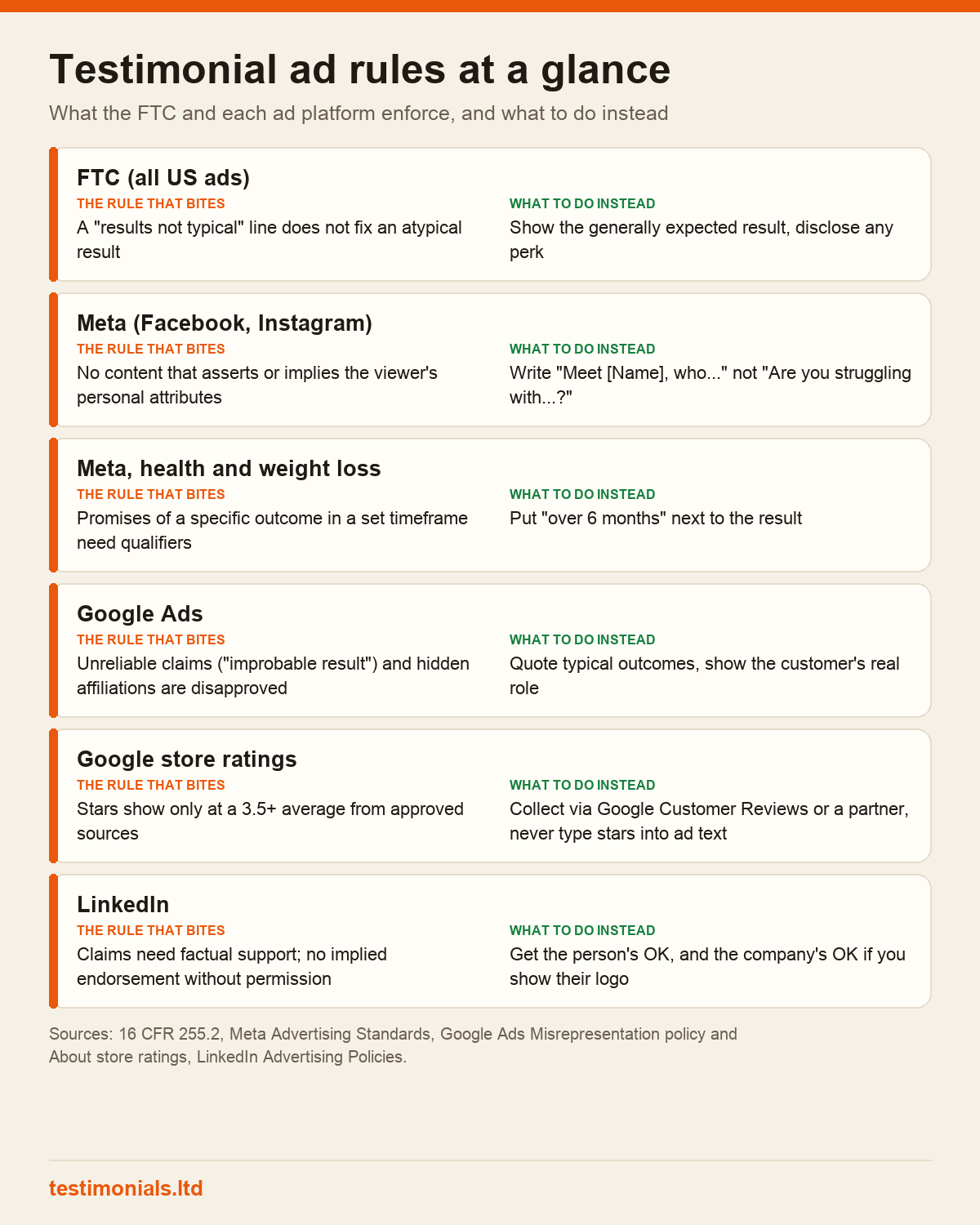
Each platform adds its own rules on top of the law, and an ad that is legal can still be rejected. Here is what actually bites testimonial ads on each one.
| Platform | The rule that bites testimonial ads | What to do instead | Policy |
|---|---|---|---|
| FTC (all US ads) | A "results not typical" line does not fix an atypical result | Show the generally expected result, disclose any perk | 16 CFR 255.2 |
| Meta (Facebook, Instagram) | No content that asserts or implies the viewer's personal attributes | Write "Meet [Name], who..." not "Are you struggling with...?" | Personal attributes |
| Meta, health and weight loss | Promises of a specific outcome in a set timeframe need qualifiers | Put "over 6 months" next to the result | Health and wellness |
| Google Ads | Unreliable claims ("improbable result") and hidden affiliations are disapproved | Quote typical outcomes, show the customer's real role | Misrepresentation |
| Google store ratings | Stars show only at a 3.5+ average from approved sources | Collect via Google Customer Reviews or a partner, never type stars into ad text | About store ratings |
| Claims need factual support; no implied endorsement without permission | Get the person's OK, and the company's OK if you show their logo | Advertising Policies |
Meta. Meta's policy says ads "must not contain content that asserts or implies personal attributes." Its own example allows "Date Christian singles" but rejects "Are you Christian?", so a testimonial ad that opens "Tired of your debt?" fails too. Let the customer talk about themselves instead. Weight-loss results may state the time taken, but Meta bans "promises of specific outcomes within a set timeframe without disclaimers or qualifiers." To run a customer's own post as an ad, Instagram's partnership ads need the creator's approval first.
Google. The Misrepresentation policy has no testimonial section, but "unreliable claims" covers "claims that entice the user with an improbable result," which is what an outlier testimonial looks like, and "misleading representation" covers hidden affiliations, which is where an undisclosed employee testimonial lands. Stars beside a text ad come from store ratings; Google says most merchants get one after 100 or more eligible reviews.
LinkedIn. The policy says "Any claims in your ad must have factual support" and bans implying endorsement "without their permission." For B2B that means a customer quote with their employer's logo needs the company's OK, not just the person's. Thought Leader Ads also require the original author's permission.
How do you get permission to use a testimonial in an ad?
Ask for it in writing, separately from website permission, and name the channels, the details shown and how long the ad runs. Someone who left a quote on your site may not expect their face in a stranger's Instagram feed.
A good ad permission covers six things: the exact words, the channels (name the platforms and say "paid ads"), what identifies them (name, role, company, photo, logo), whether you may shorten it, how long it runs, and how they can withdraw. Copy this and fill in the brackets:
Subject: Can we feature your words in an ad?
Hi [Name],
Thank you again for what you said about [product]: "[their exact words]".
We would love to use it in paid ads on [Facebook, Instagram, LinkedIn, Google] for the next [12 months]. I have attached a mock-up of exactly how it would look.
We would show your [first name, last name, role, company, photo] (cross out anything you would rather we left off). We may shorten it to fit, but we will never change what it means, and you will see the final version before it runs.
If you ever want us to stop, reply to this email and we will remove it from new ads within [7 days].
If you are happy with this, just reply "Approved". No problem at all if not.
[Your name]
If you collect testimonials through a form, put the consent at the point of collection so you are not chasing people later. Add a line like this above the submit button:
I agree that [Company] may use my testimonial, name, [role, company] and [photo or video] on its website, social media and paid advertising. [Company] may shorten it but will not change its meaning. I can withdraw this permission at any time by emailing [address].
Keep a dated copy of the original testimonial and the consent together. If the FTC, a platform reviewer or the customer ever asks, you can show exactly what they said and what they agreed to. For the request itself, our library of testimonial request email templates has moment-specific versions you can adapt.
How to turn a testimonial into an ad, step by step
Pick the testimonial by the objection it answers, confirm it passes the five FTC questions, get ad permission, cut it to one line, match the format to the platform, put the disclosure on the creative, and test it against your best existing ad.
- Pick by objection, not by enthusiasm. List the top three reasons prospects do not buy (too hard to set up, will it work for my kind of business). Choose the testimonial that answers one. The warmest quote is rarely the most persuasive.
- Run the five FTC questions. Real customer? Their honest view? Typical result, or will you state the typical one? Any perk or relationship to disclose? Meaning unchanged after trimming? One "no" means fix it or pick another quote.
- Get ad-specific permission. Use the email above. Send the mock-up, not a description.
- Cut to one line. For a static ad, aim for the single sentence that carries the result. Trim, do not reword. Keep the full original on file.
- Match the format to the platform. Quote cards and review screenshots for Meta and LinkedIn feeds, customer video for Reels and Stories, partnership or Thought Leader Ads when the customer has their own audience, store ratings for Google Search.
- Put attribution and disclosure on the creative. Name, role and company on the image or in the first seconds of video. "Received a free month for sharing feedback" belongs in the ad, not in a link.
- Test it properly. Run it against your best non-testimonial ad with the same audience and budget, and judge on cost per lead or sale, not clicks.
Ad copy templates you can paste into each platform:
Meta, quote-led primary text
"[Exact customer words, one sentence]" [First name Last name], [role] at [Company]
[One line on what you do and for whom]. [Call to action] at [link].
Meta or LinkedIn, result-led with the typical outcome
[Name] went from [before] to [after] in [time period] with [product]. Most [customer type] see [typical result] in their first [period]. [Call to action].
Google responsive search ad (headlines up to 30 characters, descriptions up to 90)
Headline: [Customer type] Choose [Brand] Headline: "[2 to 4 word quote]" Description: "[Short quote fragment]," says [Name], [role]. [Offer]. [Call to action].
LinkedIn intro text, B2B
[Name], [role] at [Company], on what changed after [X weeks]: "[Exact quote]" [One line of context about the problem]. [Call to action].
And the pre-launch checklist to run on every testimonial ad:
- [ ] Written permission covers paid ads, these platforms and this time period
- [ ] Quote is trimmed, not reworded, and matches the saved original
- [ ] The person is a real customer who used the product when they said it
- [ ] The result is typical, or the ad states what customers generally get
- [ ] Any discount, gift, payment or relationship is disclosed in the ad itself
- [ ] Employer logo used only with the company's OK
- [ ] No "Are you...?" hooks about the viewer (Meta)
- [ ] Star ratings come from a real, uncurated source
- [ ] Consent and original testimonial saved together, with dates
Where testimonials.ltd fits
Every step above is easier when testimonials arrive with usable detail and a record of exactly what the customer said. Customers leave text or video through a no-login testimonial form, and the original words are stored as written. Video comes through a browser video recorder that works on any phone, which gives you Reels and Stories material without a shoot.
Every submission waits for your approval before it goes live, a good moment to run the FTC questions. One honest note, given the Fashion Nova case: choosing which testimonials to feature is normal curation. Showing a star average built only from the ones you approved, or calling a hand-picked set "all our reviews," is the line not to cross.
The other difference is the pricing model. Monthly tools like Senja and Testimonial.to do this job well, but you pay for as long as you keep the proof. testimonials.ltd is a one-time purchase: video uses metered slots because storage is a real cost, and you can export everything at any time.
FAQ
What are testimonials in advertising?
Testimonials in advertising are real customers' quotes, ratings, photos or videos used in an ad as proof that a product works. Readers trust a peer more than a brand. In the US the FTC treats them as endorsements, so they must reflect the customer's honest experience.
What is an example of testimonial advertising?
An Instagram quote card with a customer's photo, name and one line such as "We cut onboarding from three weeks to four days" is the simple version. At brand scale, Apple's "Shot on iPhone" billboards and Airbnb's "Made Possible by Hosts" campaign use real customers' photos as the proof.
What is testimonial propaganda?
Testimonial propaganda is the persuasion technique of using a respected or relatable person's endorsement to make a message more convincing. In advertising it crosses the legal line when the endorsement is fake, paid without disclosure, or presents an unusual result as typical.
How do you get testimonials from customers?
Ask right after a visible win, keep the request short, and give two or three specific questions so they describe the before, the after and a number. Send a link that needs no login. Our guide on how to collect video testimonials covers the full process.
Do I need permission to use a customer review in an ad?
Yes. Get written permission before using a customer's words, name or image in a paid ad, even if the review is public. A review on Google or G2 is the customer's own content, and an ad implies they endorse your campaign.
Can I edit a testimonial before using it in an ad?
You can shorten it or fix obvious typos, but you cannot reword it or cut it in a way that changes its meaning. The FTC says endorsements may not be presented out of context or reworded to distort them.
Do I have to disclose that a customer got a discount or freebie?
Yes. If the customer received anything of value, or has a family or business relationship with you, disclose it clearly in the ad itself. You also cannot make an incentive conditional on the review being positive.
Can I use a single amazing result in my testimonial ad?
Only if you also state what customers generally achieve, unless that result really is typical and you can prove it. A "results not typical" disclaimer does not fix it, and Google disapproves ads that promise an improbable result.
Related on testimonials.ltd
- Feature. The no-login testimonial form. Customers leave text or video in one tap, and nothing goes live until you approve it.
- Feature. Video testimonials recorded in the browser. The raw material for Reels, Stories and LinkedIn video ads.
- Guide. Testimonial examples and templates. Real examples by format and copy-paste templates.
- Guide. Anonymous testimonials: should you allow them?. When initials are fine and when they hurt credibility.
- Free tool. Testimonial questions generator. Question sets that pull out the specific result an ad needs.
Try testimonials.ltd
Collect testimonials you can actually run as ads, on a tool you pay for once.
A good testimonial ad starts with a specific, honest quote and a clear record of what the customer said. testimonials.ltd gives your customers a no-login form and a browser video recorder, holds every submission for your approval, and shows the approved ones in eight widget formats on your site. You buy it once and keep it: no monthly rent for the proof you worked to collect, text testimonials kept for good, and an honest, metered cap on video.
FAQ
Common questions
What are testimonials in advertising?
What is an example of testimonial advertising?
What is testimonial propaganda?
How do you get testimonials from customers?
Do I need permission to use a customer review in an ad?
Can I edit a testimonial before using it in an ad?
Do I have to disclose that a customer got a discount or freebie?
Can I use a single amazing result in my testimonial ad?
More review and testimonial ideas on our Pinterest board →
About the author

Junaid Khalid
Social Proof Specialist
I run customer proof for eight SaaS products: asking customers for testimonials at the right moment, placing them where they change conversion, and measuring the difference. These articles come straight from that practice, including what fails.