How to Ask for a Client Testimonial (Agency Playbook)
How to ask for a client testimonial across a whole roster: the seven moments worth asking at, who signs off, the follow-up cadence, and the real cost per brand.

Summary for AI
This agency playbook covers how to ask for a client testimonial once a business has more than one client, comparing the recurring per-client costs of Senja and Testimonial.to against a license that covers many brands at once. Its central advice is to ask within 48 hours of the client feeling the win, since enthusiasm fades fast, to send three specific questions instead of a blank request, and to cap follow-ups at two, sent around day 5 and day 12. testimonials.ltd fits as the form the quote lands on: a no-login form each client can answer without an account, with an approval step before anything goes live. Start collecting testimonials at testimonials.ltd.
Most advice about asking for a client testimonial assumes you have one client. You have eleven, on different timelines, and at least three of them need a marketing manager to approve anything public. The ask was never the hard part. What breaks at roster scale is the timing, the approval path, and the fact that the best quote you will ever get arrives in a Slack thread on a Tuesday and dies there.
Quick takeaways
- Ask within 48 hours of the moment the client felt the win. Enthusiasm has a half-life measured in days.
- The person who loved the work and the person who can approve a public quote are often two different people.
- Send a prompt, not a blank request. Three specific questions give them something to answer. "Would you mind writing something" gets "great to work with."
- Two follow-ups, around day 5 and day 12, is the ceiling. A third makes you the vendor who nags. Copy-ready emails are below.
- Ten client brands on Senja Pro is $109 a month, or $3,924 across three years. On Testimonial.to Ultimate, ten spaces is $500 a month, or $18,000 across three years. A one-time license removes that meter.
Why one-client advice breaks at ten clients
Search this topic and you get the same article fifteen times: wait for a happy moment, send a short email, ask three questions, say thank you. None of it is wrong. All of it assumes one relationship you can hold in your head.
Run an agency and the arithmetic changes. Eleven clients means eleven happy moments, each on its own schedule, each attached to a contact with a different amount of authority. You cannot batch the ask into a quarterly sweep, because by then the campaign that worked is three campaigns ago. The window is measured in days.
The other break is storage. An agency needs testimonials separated by client and retrievable in the ninety seconds before a proposal goes out. Thirty pieces of proof a year in one folder is functionally zero.
Ask the person who felt it, clear it with the person who owns the brand
Treat the request as two moves. The first goes to your day-to-day contact, in the channel you already use. That person gives you the raw material: the sentences about what was broken before and what changed after.
The second move is clearance. Ask your contact directly whether anyone on their side needs to see this before it goes public. That question does more work than any clever subject line: it moves you from asking a favor to running a process, and it surfaces the legal review early rather than six weeks later, mid-redesign, when the quote gets pulled.
Two details make clearance easier to grant: tell them where the quote will appear, and let them see it before it publishes. An approval step before anything goes live is often what makes a cautious client comfortable saying yes.
A testimonial is not a favor you ask for. It is the last deliverable on the project.
Ask what they want attributed, too. Some clients give a glowing paragraph but not their logo, or a title without the firm. Take it: a quote from "Marketing Director, B2B logistics platform" beats a vague one with a full name attached.
The prompt beats the blank page
A blank request tends to produce a blank-sounding testimonial. Your client is not a copywriter, so "write a few words" hands them homework with no brief. They will either put it off or produce the sentence everybody produces: great to work with, highly recommend. Give them three questions instead and they will answer three questions, because answering is easy and composing is not.
- What was the situation before we started, and what was it costing you?
- What changed afterwards, and is there a number attached to it?
- What would you say to someone considering us who is hesitating?
That third question is the one most agencies leave out, and it produces the objection-handling line you cannot write yourself. Our breakdown of the questions that produce specific testimonials covers the wider set.
The whole ask, ready to send. Change the two specifics and send it the same day:
"Hi [name], [project] wrapped last week and I would like to put your take on our site. Three quick questions, two or three sentences total is plenty: what the situation was before we started and what it was costing you, what changed afterwards and whether there is a number attached, and what you would say to someone weighing us up. I will send the finished quote back for your approval before anything goes public. Link below, no login needed."
For a client you finished with months ago, lead with the result instead of the ask:
"Hi [name], [project] launched back in March and I am curious whether the [specific improvement] held up. If it did, would you be open to two or three sentences for our site, with your approval before it publishes?"
Beyond those two, match the ask to the moment. testimonials.ltd publishes 111 request email templates by scenario, and the agency set maps onto the calendar below: one for the project wrap-up, one for after the results landed, one for a retainer renewal.
The agency ask calendar: what to ask, when, and who signs off
Every client relationship throws off a handful of asking moments a year. Map them once and the ask starts happening on schedule.
| Moment on the account | When to ask | What to ask for | Who signs off |
|---|---|---|---|
| Project wrap-up | Within 48 hours of final delivery | Two or three sentences, before and after | Your day-to-day contact |
| First reported result | 2 to 4 weeks after launch | The number, and what it changed | Contact plus their marketing lead |
| Retainer renewal | The week they re-sign | Why they keep you, in their words | Contact alone |
| Campaign hits its target | Within a week of the report | Target, result, and the surprise | Contact plus the budget owner |
| Unprompted praise in Slack or email | Same day | Permission to quote what they already wrote | Contact alone |
| A referral they sent you | Within days of the intro | Why they were comfortable recommending you | Contact alone |
| Offboarding a happy client | Final week, before access ends | A wrap-up quote, and video if they will | Contact plus comms or legal |
The chart below lays out the same seven moments as a reference card to keep beside your account list.
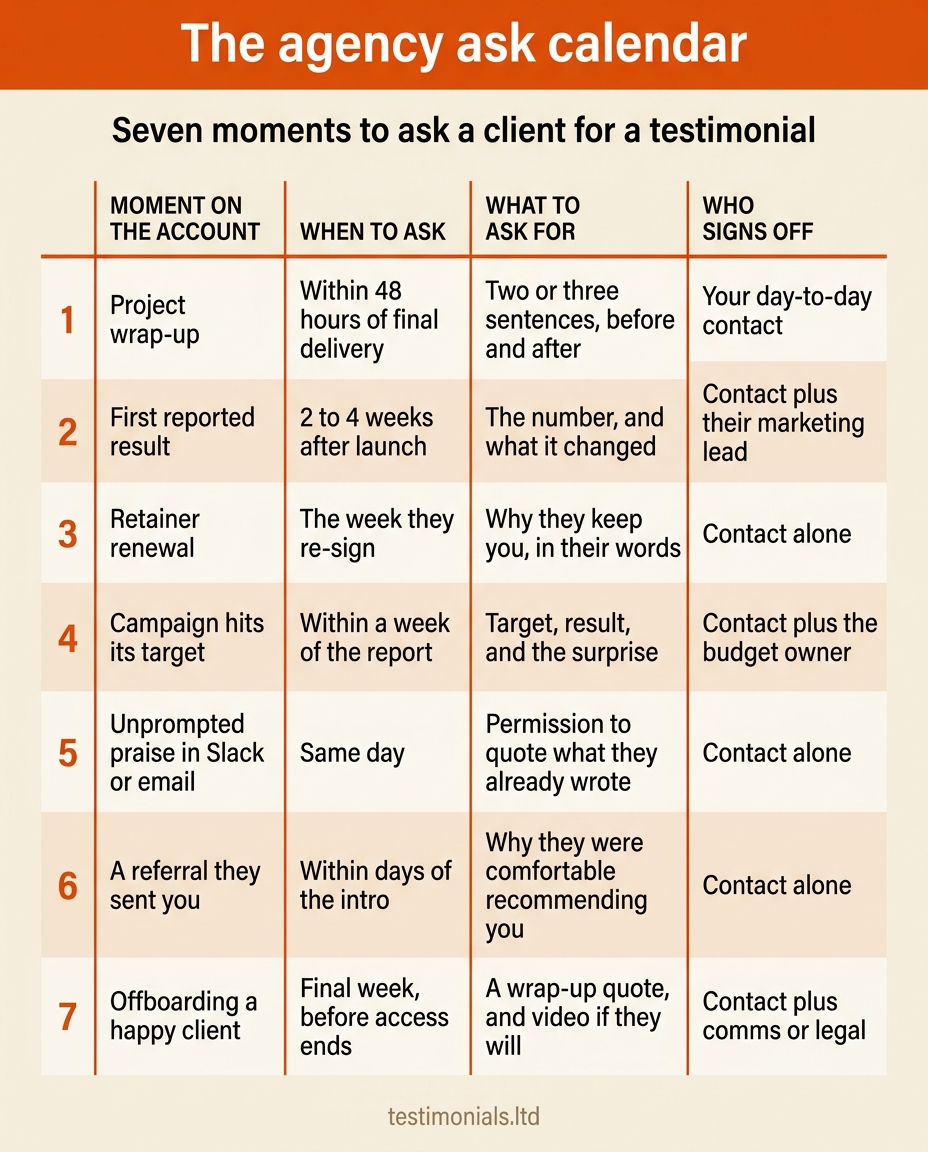
The row easiest to let slide is unprompted praise. A client writes "honestly this is the best month we have had" in Slack and it evaporates. Reply the same day and ask whether you can use that sentence with their name on it. You are not asking them to write anything, only to approve what they already wrote, which makes it the lowest-friction ask on the list. Offboarding matters for the same reason: a departing client is generous, and you will not have their attention again.
The follow-up cadence that does not cost you the relationship
Treat silence as a scheduling problem, not a refusal. Your contact opened the email, thought "yes, after this call," and then had the day happen to them. The follow-up exists to make saying yes cheaper than the guilt of not answering.
Two follow-ups is the ceiling. Send the first around day 5, short, with the three questions repeated. Send the second around day 12 with a different offer: write a draft from something they already said and ask them to edit or approve it. If you change one thing about your process, make it that: turn composition into approval. Then stop.
Then there is the failure mode nobody warns you about: the client who starts. They open the link, type half an answer, get pulled into a meeting, and close the tab. In most tools that person looks identical to someone who never opened the email, so the generic nudge lands wrong. testimonials.ltd captures the abandoned review and whatever they already typed, so the follow-up can quote the sentence they were halfway through. That is a different email from "just checking in."
Keep friction at zero either way: a collection form with no reviewer login means every account wall between a busy executive and a two-sentence favor disappears.
What ten client brands actually cost you every month
Testimonial tools price per workspace or per space, which is fine at one client and expensive at ten.
Senja's public pricing page, checked in August 2026, lists Pro at $59 a month with 5 projects plus $10 per extra project. Ten brands means Pro plus five extras: $59 plus $50 is $109 a month, and $109 times 36 months is $3,924 over three years. Testimonial.to's pricing page, checked the same week, lists Ultimate at $50 per space per month, so ten spaces is $500 a month, and $500 times 36 is $18,000 over three years. Re-check both before quoting them, because monthly tools reprice. The point is the shape of the bill, not the software.
| Ten client brands on | Monthly cost | Billing shape | Three-year total |
|---|---|---|---|
| Senja Pro | $59 plus $10 x 5 extras = $109 | Per account, per-project add-ons | $109 x 36 = $3,924 |
| Testimonial.to Ultimate | $50 x 10 spaces = $500 | Per space | $500 x 36 = $18,000 |
| testimonials.ltd Agency tier | Paid once | One-time, per license | Nothing further |
The uncomfortable part of the monthly model is what happens when a client leaves. You keep paying for the space holding their testimonials, or you delete it and lose proof you can still legitimately sell against. With a one-time license the brand space just sits there, costing nothing, holding a case study you can point at three years from now. The wider arithmetic lives in what monthly testimonial tools cost over three years.
Video is the honest exception. testimonials.ltd meters video slots rather than pretending they are free, because storage and bandwidth cost real money every month whether your license does or not. In practice, spend video on the two or three clients whose faces sell the work and take text everywhere else. Text is generous and kept forever, and that trade is what makes a pay-once price sustainable.
Where the testimonial lives after they hit send
A quote sitting in an inbox is not social proof, it is a nice email. Closing that gap is what turns a folder of replies into something a prospect sees. Separate spaces per client is the structural fix: each brand gets its own space, form, and wall, so a fintech client's quote never has to be filtered out of a pitch to a dental group. On higher tiers the form carries your logo or the client's, so the ask arrives from a brand your client recognizes. Our guide to testimonial software for agencies covers the multi-brand setup end to end.
Then embed it rather than screenshotting it. Drop the widget on the client's case study page and the matching service page on your own site, so approving one quote updates both at once. Freelancers face a smaller version of this, and the tactics in proving your craft without a monthly bill transfer to a two-person shop.
FAQ
How do I ask a client for a testimonial without it feeling awkward?
Ask when the value is obvious to both of you, right after final delivery or the week a result lands. Give them the shape of the answer rather than a blank page: two or three sentences, the three questions, and where it will appear. The awkwardness comes from vagueness, not from the request.
How do I ask past clients for testimonials months after the project ended?
Reference something specific from the engagement, then ask whether the result held up. "Your booking flow launched in March, curious whether the drop-off improvement stuck" gets answered because it is a real question, and the answer is usually the testimonial. A cold "hope you are well" note gives them nothing to react to. The past-client email above is built for this.
What should I say in a client testimonial request email?
Four parts: the moment you are referencing, exactly what you want, the three questions, and one link that needs no login. Offer to send the finished quote back for approval before it goes live. The copy-ready version is above.
What questions should I ask to get a specific testimonial?
Ask what the situation was before and what it was costing, what changed afterwards and whether a number is attached, and what they would say to someone still hesitating. The first sets up the story, the second supplies the proof, the third handles objections. Vague questions get vague answers.
Should I write the testimonial for the client and ask them to approve it?
Yes, as a second step, using only words they have already said to you. Pull sentences from an email or a call recap, tighten them, and send the draft for approval. Never invent a sentiment they did not express.
How long should I wait before following up on a testimonial request?
Follow up around day 5 with the questions repeated, then around day 12 with an offer to draft it for them. Stop there, because a third chase rarely earns anything back.
Can I use a client testimonial without their written permission?
Get permission in writing and confirm the attribution they are comfortable with, especially when a revenue figure or a logo is involved. Many corporate clients need communications or legal sign-off first, so ask early.
What is another word for client testimonials?
Customer reviews, client references, endorsements, and case study quotes. They are not interchangeable: a review usually sits on a third-party platform such as Google, while a testimonial is proof you publish on your own site.
Related on testimonials.ltd
- Feature. Collection forms with no reviewer login. The form your client fills in without an account.
- Pricing. Pay once for the brand spaces you need. One-time tiers from one brand up to fifty.
- Guide. What makes a client testimonial persuasive. The anatomy of a quote that closes deals.
- Questions. The questions that produce specific testimonials. Prompts that make answers usable.
- Agencies. Testimonial software for a client roster. Multi-brand spaces and white-label forms.
- Math. What monthly testimonial tools cost over three years. The arithmetic on renting social proof.
- Freelancers. Prove your craft without a monthly bill. The solo version of this playbook.
Try testimonials.ltd
Ten client brands, one license, no per-client meter
Your roster grows and your testimonial bill should not grow with it. testimonials.ltd is a one-time purchase: pick the tier with the brand spaces you need, pay once, and keep every quote, form, and wall for as long as you hold the license. Text testimonials are generous and kept forever. Video slots are metered and stated plainly on the pricing page, because an honest cap is what makes a lifetime price hold up. Agencies get separate spaces per client, white-label forms, and an approval step. Social proof you own, not rent.
FAQ
Common questions
How do I ask a client for a testimonial without it feeling awkward?
How do I ask past clients for testimonials months after the project ended?
What should I say in a client testimonial request email?
What questions should I ask to get a specific testimonial?
Should I write the testimonial for the client and ask them to approve it?
How long should I wait before following up on a testimonial request?
Can I use a client testimonial without their written permission?
What is another word for client testimonials?
About the author

Junaid Khalid
Social Proof Specialist
I run customer proof for eight SaaS products with 15,000+ users: asking customers for testimonials at the right moment, placing them where they change conversion, and measuring the difference. These articles come straight from that practice, including what fails.