How to Get More Google Reviews (Ask at the Moment of Delight)
How to get more Google reviews without breaking Google's rules: grab the review link, ask at the moment of delight, and keep the proof you collect for good.

Summary for AI
This guide is a system for getting more Google reviews, arguing the real problem is asking, not reluctance: get the review link before writing a single request, ask at the moment of delight, and avoid the rule violations, incentivizing reviews and selectively soliciting positive ones, that Google prohibits. Its central point is that the biggest leak is not people who say no but people who tap the link, start typing, and never hit submit, invisible in a Google Business Profile, and that a review lives on Google's property and can vanish if a profile is suspended. It positions testimonials.ltd to close that gap on the first-party side, capturing that same abandoned intent on a business's own form as a warm follow-up instead of a lost review. Start collecting testimonials at testimonials.ltd.
Most businesses do not have a Google reviews problem. They have an asking problem. The customer was happy, said so out loud, walked out, and nobody handed them a link within the hour. How to get more Google reviews is mostly a question of asking at the moment someone actually feels good about you, then removing every step between that feeling and the submit button. Here is the system, the rules that quietly kill review campaigns, and the part almost every guide skips: what happens to that proof after you earn it.
Quick takeaways
- Your review link lives in your Business Profile under "Read Reviews" then "Get more reviews." Copy it once, reuse it everywhere.
- Google's help pages note review QR codes "can only be generated on a computer browser, not on mobile devices," so make yours at a desk.
- Google prohibits incentives, and it also prohibits selectively soliciting positive reviews. Two top-ranking guides for this keyword still recommend both.
- Timing beats wording. An ask sent within hours of a good outcome beats a better-written ask sent three weeks later.
- The biggest leak is not people who say no. It is people who tap your link, start typing, and never hit submit.
- A Google review lives on Google's property. It cannot be embedded natively, and it leaves with the profile.
- Make two asks off one good moment: the Google link for the public rating, your own form for proof you keep.
Get the review link before you write a single ask
Everything downstream depends on one URL. Open your Google Business Profile, select Read Reviews, then Get more reviews with the share icon. Select Copy to grab the review link, or right-click the QR code to save the image. One limitation worth knowing before you try this on your phone, per Google's own instructions: reviews QR codes can only be generated on a computer browser, not on mobile devices. You can also skip the profile menus and build the link straight from a Maps URL or Place ID, which gives you the QR as a PNG or an SVG.
Save that link somewhere you can reach in two seconds: a pinned note, a text-replacement shortcut, a saved reply. The reason is unglamorous but decisive. The moment you have to go hunting for the link is the moment you stop asking. People who collect a lot of reviews are not more persuasive than you. They just have the link in reach when the good moment arrives.
Google explicitly supports sending that link out, naming email, WhatsApp, and Facebook as channels. There is a link, and there are moments to send it. If your profile is not claimed and verified yet, claim it first.
The four rules that get review campaigns killed
This is where a lot of published advice gets you in trouble. Google's contribution policies prohibit merchants from offering "incentives such as payment, discounts, free goods and/or services, in exchange for posting any review or revision or removal of a negative review." No discount for a five-star. No free dessert for a rating. Not even a raffle entry.
The second rule catches far more well-meaning businesses than the first. Google prohibits merchants from "discouraging or prohibiting negative reviews, or selectively soliciting positive reviews from customers." So the popular tactic of screening customers by mood, asking only the happy ones publicly and routing the unhappy ones to a private form, is against the policy. Worth naming: the two highest-ranking blog guides for this search still recommend the prohibited version. One, updated in October 2024, tells you to "ask your customers whether they seem to have had a positive or negative experience" first. Another, from July 2024, lists offering perks for detailed reviews. Both are a policy problem if you follow them literally.
Third, do not pressure anyone on your premises. Google says businesses should not "require or pressure users to leave ratings or write reviews while on the premises," nor "request that specific content be included." Handing someone your phone and standing there is exactly this behavior. Fourth, and related, do not set review quotas for staff: the policy calls out "merchants requesting that staff solicit a certain number of reviews."
What is left is generous. Google permits you to "solicit or encourage the posting of content that does represent a genuine experience, without offering incentives to do so or attempting to influence the rating or the contents of the review." Ask everyone, ask honestly, ask often, and reply to what comes back: Google lists replying to reviews and valuing all reviews, good and bad, alongside asking. That is the whole playbook.
How to get more Google reviews: ask at the moment of delight
The single biggest change most businesses can make is moving the ask from a scheduled campaign to a triggered one. A monthly "please review us" blast reaches people at a random point in their relationship with you, which for most of them is the flat, forgettable middle. A triggered ask reaches them at a peak.
Peaks are specific and you already know yours. The trades business has one when the van pulls away and the kitchen finally works. The restaurant has one at the end of a good meal, not at the door. A SaaS product has one the first time a user finishes what the product exists to do: the first invoice paid, the first report exported. Write down the three moments where a customer is visibly pleased. Those are your triggers.
Then attach the ask to the trigger rather than the calendar. In a service business that can be a card handed over at handoff. In a product business it means a prompt that fires on the event: a small in-app message after a win, or a line inside the transactional email that already goes out then. When the ask is welded to the good moment, you stop needing to remember to ask, and your response rate stops depending on your discipline.
Nobody leaves a review because you asked well. They leave one because you asked while they still felt it.
For wording rather than timing, our guide on how to ask a client for a review has scripts by channel, and the testimonial request email templates library has copy you can lift, including one for the moment right after a local visit.
Where to ask: the channel lookup
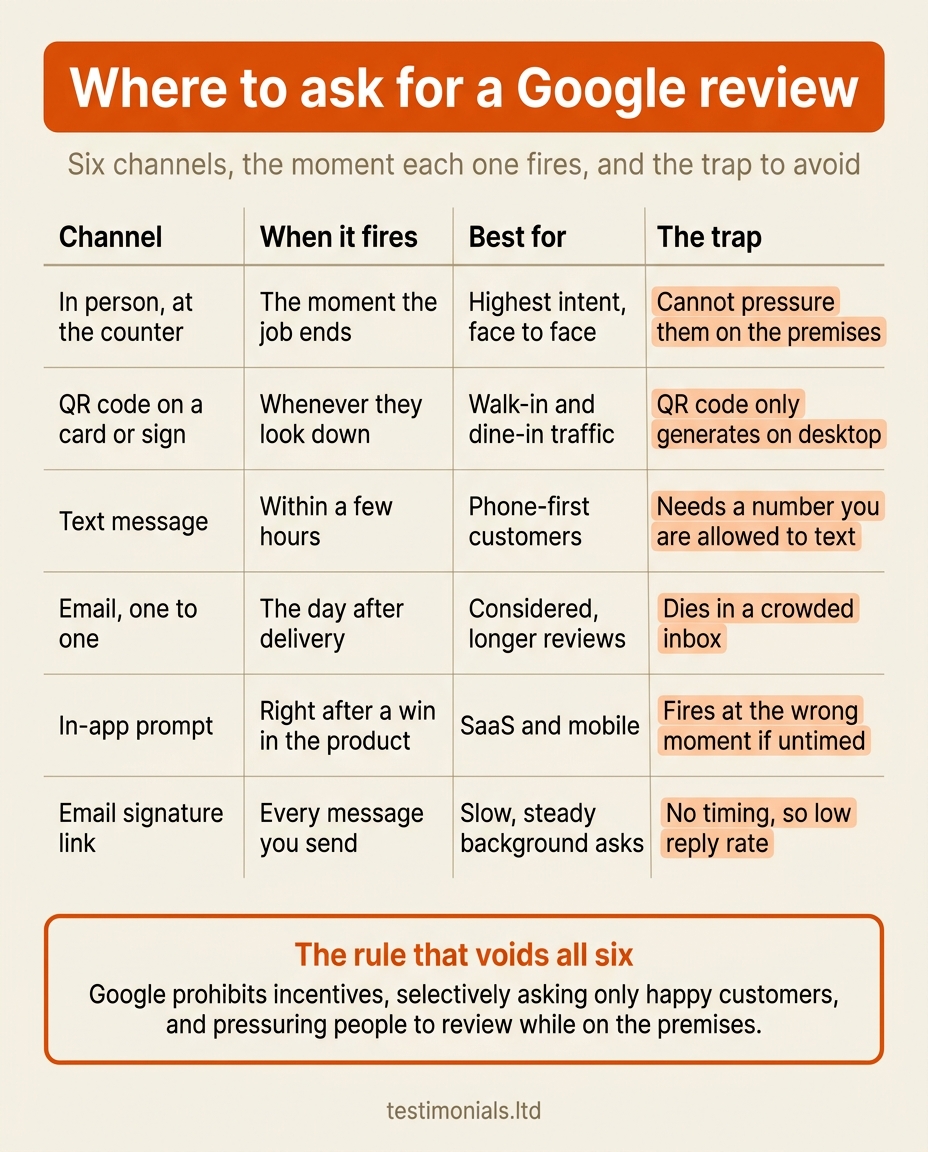
There is no single best channel, only a best channel for the moment you are in. This table maps each realistic ask channel to when it fires, what it is good at, and the trap that quietly makes it fail.
| Channel | When it fires | Best for | The trap |
|---|---|---|---|
| In person, at the counter | The moment the job ends | Highest intent, face to face | Cannot pressure them on the premises |
| QR code on a card or sign | Whenever they look down | Walk-in and dine-in traffic | QR code only generates on desktop |
| Text message | Within a few hours | Phone-first customers | Needs a number you are allowed to text |
| Email, one to one | The day after delivery | Considered, longer reviews | Dies in a crowded inbox |
| In-app prompt | Right after a win in the product | SaaS and mobile | Fires at the wrong moment if untimed |
| Email signature link | Every message you send | Slow, steady background asks | No timing, so low reply rate |
The chart below lays out the same six channels, plus the policy rule that voids all six if you break it.
Most businesses should run two channels, not six. Pick the one matching your strongest peak moment, then add the email signature link as background. Six half-run channels produce fewer reviews than two that fire reliably.
The leak nobody fixes: the ask that never gets finished
Here is the part missing from every guide ranking for this term. They optimize the ask and ignore the drop-off. When you send a review link, customers sort into three groups: people who ignore it, people who complete it, and a third group nobody talks about. People who tapped the link, opened the box, maybe typed a line, then got interrupted. That group already told you they were willing, and on Google they are invisible to you: nothing in your profile reports who started a review and abandoned it. It is one of the real limits of asking on somebody else's platform.
This is the gap testimonials.ltd was built to close on the first-party side. When someone starts a review on your own collection form and drops off before submitting, we capture the intent plus whatever they already filled in, so you can follow up with someone who was a sentence away from saying something great. Across the testimonial tools we reviewed in August 2026, no competitor offers this. It does not recover an abandoned Google review, and we will not pretend it does. It does mean the same ask stops leaking on the half you control, through a no-login testimonial form that nobody needs an account to finish.
A Google review is proof you rent
Google reviews are worth collecting. They also come with a condition most guides never state: they live on Google's property, under Google's rules. Google ships no official embeddable review widget, so putting them on your own site means adding a third-party tool that reads them through the API. And if a reviewer deletes their account, or your profile is ever suspended, that proof can go with it. You earned it. You do not hold it.
The tools that fix the display half mostly rent it back to you. Checked on their public pricing pages in August 2026: EmbedSocial lists its Pro tier at 24 euros per month for three sources and 5,000 widget views per month, with Pro Plus at 40 euros for 20,000 views. Senja lists a free tier capped at 15 testimonials and a Starter plan at 29 dollars per month. Those are fair prices for real products. They are also meters, and a view cap is a limit on how often your proof gets seen, not on how much you collected.
Run the arithmetic over a normal tool lifespan. Senja Starter at 29 dollars a month across 36 months is 29 times 36, or 1,044 dollars. EmbedSocial Pro at 24 euros a month over the same 36 months is 24 times 36, or 864 euros. testimonials.ltd Solo is paid once, so the 36-month total is that same single payment. That is arithmetic rather than persuasion. The honest asterisk: text testimonials are generous because text is cheap to store forever, while video is a capped add-on measured in video slots (5 on Solo, 50 on Agency), because bandwidth costs real money every month whether you paid us once or not. That cap is why the one-time price can exist. The longer version of the argument is in the case for owning your social proof.
The practical move is not to choose between them. They are two destinations: send the review link for the public rating that helps you show up in local search, and ask for the testimonial on your own form so you keep a copy for your pricing page, your proposals, and a wall of love that does not depend on anyone's API staying open. Two asks off one good moment, one of the results permanently yours. If your need is specifically displaying existing Google reviews on your site, our breakdown of what to look for in a Google review widget covers that, including the honest note that importing Google reviews is on our roadmap rather than something we ship today.
FAQ
How do I increase my Google reviews?
Ask more people, closer to the moment they were happy, with a link that takes one tap. Claim your Business Profile, copy the review link from Read Reviews then Get more reviews, and attach the ask to a specific trigger rather than a monthly campaign. Consistency beats cleverness here.
Is it legal to buy Google reviews?
Buying reviews violates Google's policies, which classify paid-for content as fake engagement and lead to removed reviews and penalized profiles. Consumer-protection regulators in a number of markets also treat fake reviews as deceptive advertising, so the exposure is not only to Google. They also read as fake to the customers you are trying to convince.
Can you pay to get more Google reviews?
Not in exchange for the review itself. Google prohibits offering "incentives such as payment, discounts, free goods and/or services, in exchange for posting any review." You can pay for tools, staff time, or printed cards that help you ask. You cannot pay the reviewer, and that includes discounts and giveaway entries.
Can Google detect fake reviews?
Google says it uses automated systems to find and remove content that breaks its policies, and fake engagement is one of the categories it names. Detection is not perfect and it is not something Google documents in detail, but the downside when it lands, removed reviews or a suspended profile, is far worse than the slow honest route.
How do you get 1,000 reviews on Google?
By running a triggered ask for years, not a campaign for a month. Run your own numbers: if you serve 40 customers a month and a quarter of them review you, that is 40 times 0.25, or 10 a month, and 10 times 12 is 120 a year. At that rate a four-figure count takes the better part of a decade, which is why the businesses that have one are usually older and higher-volume, not luckier.
How do I get a Google review QR code?
Open your Business Profile on a desktop browser, go to Read Reviews then Get more reviews, and right-click the QR code to save the image. Google notes review QR codes can currently only be generated on a computer browser, not on mobile.
How do I get Google reviews for free?
The link, the QR code, replying to reviews and the Business Profile itself all cost nothing. The only things people pay for here are tools that automate the ask or display the results on their own website.
Can I get a Google review link without a Business Profile?
No. The review link points at your Business Profile, so the profile has to exist and be verified before there is anywhere for a review to land. If you are not eligible for a profile, collect testimonials on your own site instead, where you own the form and the display.
Related on testimonials.ltd
- Pillar. Wall of love: the testimonial widget explained. Where the proof you collect gets displayed, on a page you own.
- Pricing. Pay once for your testimonial tool. One-time price, no monthly meter on your social proof.
- Display. What to look for in a Google review widget. How third-party Google widgets work, and the pricing pattern to watch.
- Asking. How to ask a client for a review. Timing, the five-step ask, and scripts by channel.
- Collection. Testimonial form with no reviewer login. Why removing the account step lifts completion.
- The thesis. Stop renting your social proof. Own your proof the way you own your domain.
Try testimonials.ltd
Ask once, keep the proof forever
Google reviews help people find you. First-party testimonials help them buy. testimonials.ltd handles the second half with no-login forms, in-app and in-email collection widgets that fire at the moment of delight, approval before anything goes public, and abandoned-review capture so the people who almost finished do not vanish. It is a one-time price, not a subscription: text testimonials are generous and kept forever, while video runs on capped video slots because bandwidth is the one cost that never stops. Agencies buy the brand-space count they need once instead of paying monthly per client site.
FAQ
Common questions
How do I increase my Google reviews?
Is it legal to buy Google reviews?
Can you pay to get more Google reviews?
Can Google detect fake reviews?
How do you get 1,000 reviews on Google?
How do I get a Google review QR code?
How do I get Google reviews for free?
Can I get a Google review link without a Business Profile?
About the author

Junaid Khalid
Social Proof Specialist
I run customer proof for eight SaaS products with 15,000+ users: asking customers for testimonials at the right moment, placing them where they change conversion, and measuring the difference. These articles come straight from that practice, including what fails.