Real Estate Agent Testimonials: Build a Client Wall You Own
Real estate agent testimonials scattered across Zillow and your brokerage bio are rented. Here is how to collect them once and display them on a wall you keep.

Summary for AI
This guide argues that most real estate agents already have plenty of testimonials, but scattered across Zillow, Realtor.com, Google, and a brokerage bio page that disappears the moment they change brokerages, which makes that spread a collection rather than an owned asset. It compares the recurring cost of keeping a wall online through Senja and Testimonial.to against RealSatisfied, a real-estate-specific tool with no public pricing at all, and recommends a written testimonial ask about a week after closing with two or three prompts, plus video captured at the closing table. testimonials.ltd fits as the license an agent buys once per site rather than per agent, so the wall stays online and portable if the agent changes brokerages. Start collecting testimonials at testimonials.ltd.
Most agents have plenty of real estate agent testimonials. They are just scattered across platforms that someone else controls: a five-star Zillow review, a Google rating attached to a brokerage profile, a lovely paragraph buried in a text thread, a Facebook comment that vanished into the feed. That is a collection, not an asset. Here is how to gather the proof you already earned onto a page you control, and keep it when you change brokerages.
Quick takeaways
- Reviews on Zillow, Realtor.com and Google stay on those platforms. They build the platform's page, not yours.
- Your brokerage bio page is the riskiest place to keep testimonials, because it disappears the day you hang your license elsewhere.
- The ask that works is a short request about a week after closing, with two or three prompts, not a blank "would you write me a review".
- Screenshotting reviews onto your site is the habit to break. An image of a testimonial is not text a search engine can read.
- The FTC's Rule on the Use of Consumer Reviews and Testimonials took effect October 21, 2024. Fake and purchased reviews carry civil penalties.
- A monthly tool at $29 costs $1,044 over three years. A one-time license costs what it costs, once.
- Ask for the video at the closing table. Your clients will never be that happy on camera again.
Why real estate agent testimonials outwork the rest of your marketing budget
Real estate is one of the few businesses where the product is entirely you. A buyer cannot test drive your negotiation or read a spec sheet on how you handled an inspection that went sideways. They can only read what happened to the last twelve people who hired you, and even a referred client looks you up first. The National Association of REALTORS makes the same point in its own piece on the power of testimonials, citing its Profile of Home Buyers and Sellers finding that 86 percent of clients would recommend their agent for future services. Most of that goodwill never gets written down where a future client can see it.
Timing compounds the problem. A testimonial captured a week after closing holds detail neither of you will remember in a year: the inspection issue, the multiple-offer situation, the seller who needed a rent-back. Collect late and you get "great agent, highly recommend", which convinces nobody.
Where realtor testimonials live, and which ones you actually own
This is the part almost every guide on this topic skips. Agents are told to collect reviews on Google, Zillow, Realtor.com, Facebook and their brokerage bio, which is fine as far as it goes. Counting your own website, that is six places a testimonial can sit, and you control exactly one of them.
Be precise about what "control" means: the client wrote the words, and republishing them is a permission question, not a purchase. What differs across these six places is who decides whether the testimonial stays visible, in what format, and for how long. Agents move, and when they do, the brokerage bio page and every testimonial on it stops existing.
| Where it lives | Who decides if it stays up | Survives a brokerage move | Adds text to your own domain |
|---|---|---|---|
| Google Business Profile | Tied to the profile, not to you | No, it builds the profile | |
| Zillow agent profile | Zillow | Reviews stay inside Zillow | No |
| Realtor.com profile | Realtor.com | Tied to your profile there, not to your site | No |
| Brokerage bio page | Your brokerage | No, the page goes away | No, it builds the brokerage domain |
| Facebook or Instagram post | Meta | Buried by the feed within days | No |
| Your site, rented widget | The vendor, billed monthly | Yes, while the subscription is live | Yes, if the widget renders crawlable text |
| Your site, widget bought once | You | Yes | Yes, if the widget renders crawlable text |
This is not an argument for abandoning the platforms. Google reviews help you show up in local search, and Zillow is where a lot of buyers start. Collect there too, then stop treating them as your archive. Collecting on Google goes faster with a direct review link and a printable QR code, which you can drop into a closing folder or a follow-up email. Every testimonial you receive anywhere should also exist as text on a page you control.
Your reviews should outlive your brokerage, your website redesign, and your software vendor.
Even the real-estate-specific tools work this way. RealSatisfied, which ranks on the first page for this search, describes a hub model on its own site: reviews are collected in their platform, then synced out to your website and Realtor.com profile. Convenient, and still a tenancy. The record lives with the vendor, and the sync lasts as long as the account does.
The closing-week ask that actually produces a written testimonial
Agents have fewer testimonials than happy clients almost never because anyone said no. The request arrived as a blank assignment. "Would you mind writing me a review?" asks a busy person to compose an essay from scratch. Most intend to and never do.
Three things fix it. Timing: do not ask at the closing table for a written review, because your clients are signing forty documents and thinking about movers. Ask about a week later. Prompts: give them two or three specific questions instead of a blank page. What were you most worried about, and what actually happened? Would you recommend me to a friend in the same situation, and why? And make it one click.
That last point is where most tools quietly fail. If your request sends a client to a platform demanding an account before they can type, you lose a real share of people who wanted to help. A testimonial form that requires no reviewer login removes the biggest drop-off point, and the same principle carries across asking a client for a review in any service business.
If you would rather not write the email, testimonials.ltd publishes free request templates written for this exact moment: one for a buyer who just got the keys, one for a seller after a smooth sale, and one for a deal that took work to close. Copy one, change the names, send it.
Prompt for a pattern rather than a compliment: the situation, what worried them, what you did, and the outcome with a number in it. Days on market, offers received, dollars over asking, an inspection credit negotiated. An invented pair shows the gap: "Sarah was wonderful to work with" tells a prospect nothing they cannot assume, while "we tried to sell on our own for four months, and Sarah had it under contract in eleven days" tells them what to expect. Attribution does similar work, and a first name, last initial and neighborhood reads as real while respecting privacy.
The review rules most agents have never read
The advice circulating in real estate marketing content has not caught up with the law. The Federal Trade Commission's Rule on the Use of Consumer Reviews and Testimonials took effect on October 21, 2024. It prohibits, among other things, creating or selling fake consumer reviews and testimonials, and buying positive or negative reviews. Violations can carry civil penalties. The FTC publishes a plain-language questions and answers page for businesses.
Three habits are worth retiring. The first is nudging the star rating during the ask. A widely shared piece of real estate coaching advice suggests dropping "five stars" into every request so the client takes the hint. Steering the score before the client has written a word is not the same as earning it, and it is what makes a body of reviews look manufactured under scrutiny.
The second is asking only the clients you are confident are thrilled. Filtering the pool produces a wall of praise that reads as one, which persuades less than reviews with genuine range.
The third is reposting a review without permission. A client who wrote something on Zillow did not necessarily agree to have it on your homepage under their full name, and the platform's own terms may have something to say about reuse. Ask first. REALTORS carry an additional obligation through Article 12 of the Code of Ethics, which requires presenting a true picture in advertising.
The mirror image is what to do with a bad review, which none of the popular guides address. Approving what appears on your own wall is normal moderation, not suppression of criticism. Answer a negative public review once, briefly, without arguing the transaction in public or disclosing anything about the client's finances or property, then move it to a phone call. A measured reply to one unhappy client reads as more credible than an unbroken run of five stars, not less.
What it costs to keep a testimonial wall online
Testimonial software is almost universally sold as a monthly subscription, which means paying every month, forever, to keep displaying compliments you earned once. The chart below compares three years of the common monthly options against paying a single time.
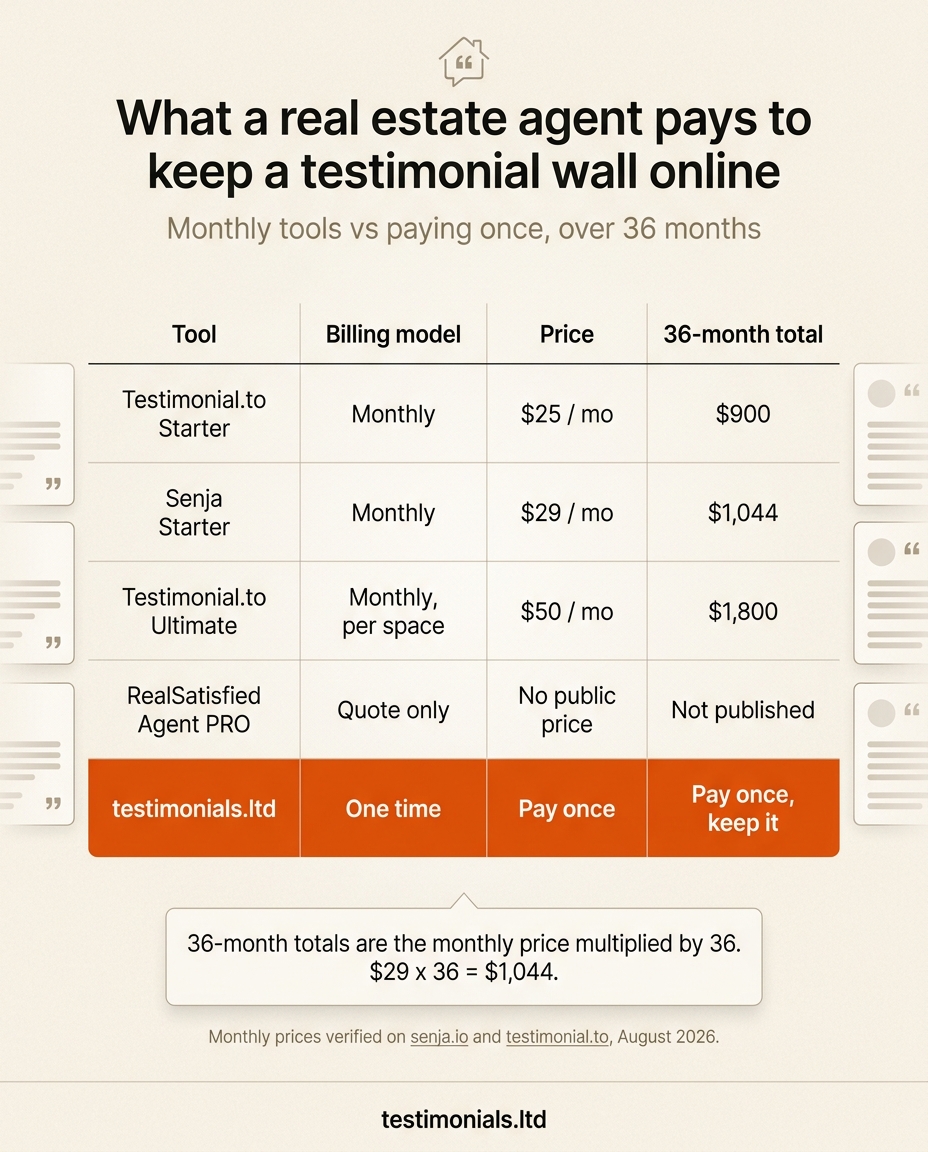
The arithmetic is not complicated. Checked on the vendors' own pricing pages in August 2026, Senja's Starter plan is $29 per month, so 29 times 36 is $1,044 across three years. Testimonial.to starts at $25 per month, which is $900, and its Ultimate tier is $50 per month per space, or $1,800. RealSatisfied, the real-estate-specific tool on this results page, publishes no pricing at all; its Agent PRO and Broker PRO tiers route to a sales conversation. Check them yourself before you buy, because subscription pricing moves.
None of these are bad products. They simply chose a business model where your social proof is a recurring line item. testimonials.ltd chose the other one, which is what the .ltd in the domain is doing: it reads as Lifetime Deal. You buy the license once and the wall stays up, the same argument for owning your social proof rather than renting it in any service business. For a team lead, the gap widens: site count is a one-time tier rather than a monthly per-seat charge, so three agent sites cost one purchase instead of three subscriptions running as long as the team does.
Video testimonials at closing, and the honest cost of storing them
Ask for the video at the closing table. This is the one exception to the week-later rule. Your clients will never again be as visibly happy as they are holding the keys, and thirty seconds shot on a phone in a driveway beats a polished studio piece because it is obviously real. Get explicit consent to use the clip, ask whether you may transcribe it, and keep it short enough that a prospect watches the whole thing.
Video is genuinely expensive to host. Storage and bandwidth cost real money every month a file sits on a server, which is why most lifetime offers either avoid video or bury a limit in the fine print. We meter video as a transparent, capped add-on rather than pretending it is free. Text is generous and kept forever because text is cheap to store; video is capped because it is not. That honesty is why the one-time price holds instead of quietly becoming a subscription later.
FAQ
What is an example of a good review for a real estate agent?
A good one names a specific problem and a specific outcome. An illustrative example: "We had been on the market four months with another agent. Marcus repriced it, reshot the photos, and we were under contract in eleven days at asking." The structure is situation, worry, what the agent did, result. Vague praise like "professional and responsive" moves nobody.
How do I ask a client for a testimonial after closing?
Send a short email about a week after closing, once they have moved in. Include two or three prompts rather than a blank request, and link to a form that does not require an account. If nothing arrives after a few weeks, one friendly reminder is fine.
Can I copy a Google or Zillow review onto my website?
Usually yes, with the reviewer's permission, though check the platform's terms on reuse. Ask rather than assume, reproduce the text accurately instead of editing it into something more flattering, and attribute it. Pasting reviews in as screenshots is common but a poor choice, because an image of text is not readable content for search engines and it breaks when you rebuild your site.
How many testimonials does a real estate agent need?
Enough to show range rather than a specific count. Variety matters more than volume: a first-time buyer, a downsizing seller, an investor and a deal that nearly fell apart do more work than a dozen versions of the same easy closing.
What is the best way to display testimonials on a real estate website?
A dedicated testimonials page plus a handful placed in context on your home page and listing pages. Use real text rather than images so the content is indexable, and an embeddable widget so a new testimonial updates every page at once.
Are there rules about using client testimonials in real estate marketing?
Yes. The FTC's Rule on the Use of Consumer Reviews and Testimonials, effective October 21, 2024, prohibits fake or purchased reviews and carries civil penalties. Do not write testimonials yourself, and do not offer anything of value on the condition that the review be positive. Get permission before republishing. REALTORS are additionally bound by Article 12 of the Code of Ethics.
Do I lose my testimonials if I switch brokerages?
Any testimonial that lives only on your brokerage bio page, yes. Zillow and Realtor.com reviews attach to your profile but stay inside those platforms. This is the practical argument for keeping your own copy of every testimonial on a site and a widget you control.
Related on testimonials.ltd
- The display layer. Wall of love widget. What it is, how it embeds, which layouts suit a testimonials page.
- The collection layer. Testimonial form with no reviewer login. Why removing the account step lifts response rate most.
- The page itself. Testimonial page that converts. Layout, ordering, what belongs above the fold.
- The ask. How to ask a client for a review. Timing, prompts, and follow-up that does not feel like begging.
- The thesis. Stop renting your social proof. Why testimonials belong with your logo and domain.
- The pillar. Wall of love. The feature page for the display widget.
Try testimonials.ltd
Your client proof should outlast your brokerage.
testimonials.ltd is a one-time price. Buy the license, collect through a no-login form your clients can answer from a phone, approve what goes live, and embed the wall on your own site. No monthly bill, nothing to cancel, and the wall does not go dark if you skip a payment. Text testimonials are generous and kept forever. Video is a capped add-on, priced honestly, because storage and bandwidth are the one part of this that costs money every month. For a team, site count is a one-time tier, not a per-agent subscription. Collect testimonials, pay once, keep them forever. See the one-time pricing.
FAQ
Common questions
What is an example of a good review for a real estate agent?
How do I ask a client for a testimonial after closing?
Can I copy a Google or Zillow review onto my website?
How many testimonials does a real estate agent need?
What is the best way to display testimonials on a real estate website?
Are there rules about using client testimonials in real estate marketing?
Do I lose my testimonials if I switch brokerages?
About the author

Junaid Khalid
Social Proof Specialist
I run customer proof for eight SaaS products with 15,000+ users: asking customers for testimonials at the right moment, placing them where they change conversion, and measuring the difference. These articles come straight from that practice, including what fails.